Cello cases and gig bags
A cello is the only school instrument a child cannot carry under one arm, and the case decides whether it comes to lessons or stays in a hallway.
By Stephen V. · Writes Reed & Rosin · last verified
The short answer
For a full-size school cello, the MI&VI CB-5001 gig bag is the pick: 12 mm of published padding and backpack straps for commuting. Get the size right first — a 1/2-size cello needs a 1/2 bag, and a hardshell case is the only real impact protection.
Some links on this page earn us a commission at no extra cost to you. It does not change which instrument we recommend, and it does not change the order. We also earn nothing when the honest answer is “rent it” — and we still say so. Full disclosure.
Quick picks
| # | Product | Best for | Score | Price |
|---|---|---|---|---|
| 1 |  MI&VI CB-5001 Cello Soft Case Gig Bag, 4/4, 12 mm Padding The bag to buy for a full-size school cello: 12 mm of padding is a published figure rather than the word padded, and the backpack straps are the difference between a cello that gets to lessons and one that stays home. | A full-size school cello on a weekly commute | 9.0/10 | $72.99View on Amazon #ad · price as of October 27, 2026 · how this is funded |
| 2 | 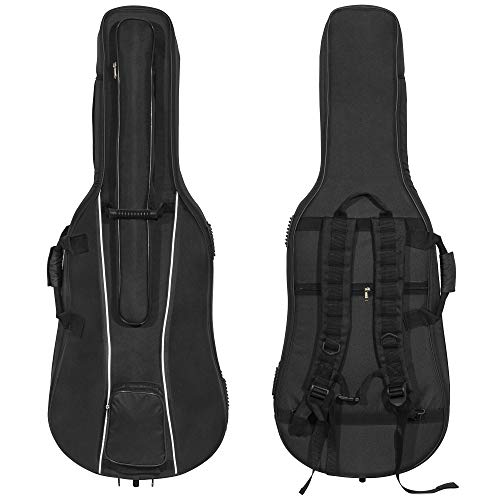 MI&VI CB-5005 Travel Cello Soft Case Gig Bag, 1/2 Size, 20 mm Padding The 1/2-size bag that publishes a padding figure instead of the word thick: 20 mm, on a 1200D weather-resistant shell. It costs around three times a basic 1/2 bag, which is the right arithmetic on an owned instrument and an arguable one on a rental. | An owned 1/2-size cello that goes to school | 8.8/10 | $119.99View on Amazon #ad · price as of October 27, 2026 · how this is funded |
| 3 |  Sky CESB001 Cello Gig Bag, 1/2 Size, Padded A padded bag in a size most listings skip: 1/2, which is what a nine or ten year old plays. A bag this cheap is weather and scuff protection, not impact protection, and should be bought knowing that. | A 1/2-size school cello that travels by car | 8.0/10 | $39.99View on Amazon #ad · price as of October 27, 2026 · how this is funded |
| 4 |  Crossrock ABS Cello Case for 4/4 and 3/4, Molded Hardshell with Wheels The only real answer when the cello is worth protecting: a molded hardshell with wheels, a lock and bow holders. It costs more than some student cellos, which is exactly the calculation to do before buying it. | An owned cello, a bus route, or air travel | 9.2/10 | $358.99View on Amazon #ad · price as of October 27, 2026 · how this is funded |
Scores are our own editorial fit rating from published specifications — the rubric is on our methodology page. They are not test results; we have not played these instruments.
Buying this as a gift? Our gift guides re-explain these picks for the gifter. Wondering whether to wait for November? The Black Friday hub has the sourced record of what discounted last year and what did not.
Match the case to the cello, not to the player
Cellos are sold in fractional sizes — 4/4, 3/4, 1/2, 1/4 — and cases are too, but most listings default to 4/4 because that is what sells in volume. A sized student cello in a 4/4 bag slides around inside it, which converts every bump in a car boot into a knock against the bridge or the scroll. The sizing method is on the cello size chart; if the instrument is rented, the rental paperwork states its size.
This matters more on cello than on any other school instrument because of how a cello travels: upright, on a back, through doorways and bus aisles, carried by someone who is shorter than it is. Two of the four picks below are 1/2-size specifically, because that is the size most nine to eleven year olds play and the hardest size to buy a bag for.
What a soft bag actually protects against
Honesty first: a padded gig bag protects against weather, dust and scuffs, and against the light knocks of ordinary handling. It does not protect against a drop, a fall down a staircase, or another child walking into it in a corridor. A hardshell case protects against those things and costs more than some of the student cellos in this registry — which is exactly the arithmetic to do before buying one.
The useful specification on a soft bag is the padding thickness in millimeters, and the reason the MI&VI CB-5001 leads this page is that it publishes one: 12 mm, with 20 mm on its 1/2-size sibling. Most bags say “padded” or “thick foam” and leave it there, which cannot be compared to anything. Where a maker does not publish a figure, the specs table on this page says so rather than inventing one.
| Case | Size | Type | Padding | Carry |
|---|---|---|---|---|
| MI&VI CB-5001 | 4/4 | Soft gig bag | 12 mm, waterproof outer | Adjustable backpack straps |
| MI&VI CB-5005 | 1/2 | Soft gig bag | 20 mm, 1200D weather-resistant shell | Backpack straps and grab handles |
| Sky CESB001 | 1/2 | Soft gig bag | Not published | Back straps and handle |
| Crossrock ABS | 4/4 and 3/4 | Moulded hardshell | Hardshell with velvet interior | Wheels and backpack straps |
We have not handled these cases and hold no drop-test results. The table above is what the makers publish, read on a dated visit — see how we work.
Straps, wheels and the school-bus question
Backpack straps are the feature that decides whether a cello travels. A single shoulder strap on a case that comes up to a child’s chin leaves no free hands for doors, stairs or a bag of books, and a child with no free hands drags the case instead. Two straps and a top handle is the minimum specification for a student who walks any distance.
Wheels change the equation again, and they are the real argument for a hardshell at this level: a wheeled case can be pulled by a player too small to carry the instrument on their back at all. The trade-off is weight and bulk in a car every day, and wheels are no use at all on stairs.
One more practical point specific to cello: check that the case has a bow holder, and preferably two. A loose bow inside a bag with the instrument is a scratched cello and a warped bow, and cello bows are not cheap to replace — see cello bow and rosin.
Rented cello, owned cello
If the cello is rented, read the agreement before buying a case: many rental programs include one, and many make the renter liable for damage whether or not the supplied case was adequate. A better bag on a rented instrument is often a sensible small purchase for exactly that reason, and the rest of the arithmetic is on rent versus buy for cello.
If the cello is owned and the student is past the sized instruments, this is the moment a hardshell case starts to make sense — particularly if the journey involves a bus, a bike rack or a flight. Up to that point, a well-padded bag with two straps is the honest answer and leaves the money where it does more good: on the instrument, the bow and the lessons.
Labeling, storage and packing the thing
A school orchestra room has a rack of near-identical black cello bags in it, which is why the first thing to do with a new case is label it inside and out: a luggage tag with a name and a phone number on the handle, and the same information on a card inside the pocket. Cases are picked up by mistake constantly, and a labeled case comes back while an unlabeled one becomes an argument. If the instrument is insured or is a rental, note the policy or agreement number on the inside card too — it is the information nobody can find on the day they need it.
Packing matters more on cello than on any other school instrument. Retract the endpin fully before the cello goes in the bag; an extended endpin is the single most common cause of a torn case lining and a bent pin. Loosen the bow before it goes in its holder, every time, because a bow left tight warps. And do not store anything loose in the main compartment with the instrument: a rosin cake or a tuner rattling against the front is a scratch waiting to happen, which is what the accessory pockets are for. For school storage, stand the case upright against a wall rather than laying it flat where someone will put a bag on it.
Before you add it to the basket
Confirm the cello’s fractional size, then buy that size of case. Check for backpack straps and a bow holder. Only move up to a hardshell when the instrument is owned, or when the daily journey genuinely risks a knock a padded bag will not stop.
The picks, in full
Every card below is written from the published specification and the manufacturer’s own documentation. We have not played these instruments — see how we work for exactly what that means and what we do instead.
Our top pick · A full-size school cello on a weekly commute
MI&VI CB-5001 Cello Soft Case Gig Bag, 4/4, 12 mm Padding
The bag to buy for a full-size school cello: 12 mm of padding is a published figure rather than the word padded, and the backpack straps are the difference between a cello that gets to lessons and one that stays home.
What works
- 12 mm padding thickness published, so it can be compared rather than trusted
- Backpack straps plus multiple pockets for a bow, rosin and music
- Waterproof outer and a non-abrasive lining per the listing
What to know
- Still a soft bag — a hard case is the only real impact protection
- 4/4 only on this listing, so it is wrong for a sized student cello
- Size
- 4/4
- Padding
- 12 mm
- Carry
- Adjustable backpack straps
- Outer
- Waterproof, non-abrasive lining
#ad · price as of October 27, 2026 · how this is funded
Specs read from the manufacturer or retailer listing on 2026-10-17. Our fit score: 9.0/10.
Pick 2 · An owned 1/2-size cello that goes to school
MI&VI CB-5005 Travel Cello Soft Case Gig Bag, 1/2 Size, 20 mm Padding
The 1/2-size bag that publishes a padding figure instead of the word thick: 20 mm, on a 1200D weather-resistant shell. It costs around three times a basic 1/2 bag, which is the right arithmetic on an owned instrument and an arguable one on a rental.
What works
- 20 mm padding published as a figure, so it can be compared rather than trusted
- 1200D non-abrasive nylon shell described as weather-resistant on the listing
- Adjustable backpack straps, multiple grab handles, bow holder and a rear sheet-music pocket
What to know
- Around three times the price of a basic bag in the same size
- Still a soft bag — only a moulded hardshell protects against a drop
- 4.15 lb and 18 in across, so it is bulkier than a thin 1/2 bag in a car boot or a locker
- Size
- 1/2
- Type
- Padded soft gig bag
- Padding
- 20 mm
- Shell
- 1200D nylon, weather-resistant, non-abrasive lining
- Carry
- Adjustable backpack straps and multiple grab handles
- Weight
- 4.15 lb
#ad · price as of October 27, 2026 · how this is funded
Specs read from the manufacturer or retailer listing on 2026-10-25. Our fit score: 8.8/10.
Pick 3 · A 1/2-size school cello that travels by car
Sky CESB001 Cello Gig Bag, 1/2 Size, Padded
A padded bag in a size most listings skip: 1/2, which is what a nine or ten year old plays. A bag this cheap is weather and scuff protection, not impact protection, and should be bought knowing that.
What works
- Actually made in 1/2 size, where most cello bags start at 4/4
- Back straps and a handle, so a child can carry it without dragging the instrument
- Cheapest way to stop a rental cello collecting scratches
What to know
- Thin padding — it will not survive a drop or a bus-aisle knock
- No wheels, and a cello case is awkward for a small child however light it is
- Size
- 1/2
- Type
- Padded soft gig bag
- Carry
- Back straps and handle
- Padding
- Not published
#ad · price as of October 27, 2026 · how this is funded
Specs read from the manufacturer or retailer listing on 2026-10-17. Our fit score: 8.0/10.
Pick 4 · An owned cello, a bus route, or air travel
Crossrock ABS Cello Case for 4/4 and 3/4, Molded Hardshell with Wheels
The only real answer when the cello is worth protecting: a molded hardshell with wheels, a lock and bow holders. It costs more than some student cellos, which is exactly the calculation to do before buying it.
What works
- Moulded ABS hardshell — actual impact protection rather than scuff protection
- Wheels, which is what makes a cello portable for a smaller player
- Fits 4/4 and 3/4, dual bow holders, lock and backpack straps
What to know
- Costs more than several of the student cellos in this registry
- Heavy and bulky; a soft bag is easier in a car every single day
- Fits
- 4/4 and 3/4
- Shell
- Moulded ABS hardshell
- Transport
- Wheels, backpack straps
- Fittings
- Lock, dual bow holders, velvet interior
#ad · price as of October 27, 2026 · how this is funded
Specs read from the manufacturer or retailer listing on 2026-10-17. Our fit score: 9.2/10.
Questions people actually ask
What size cello case do I need?
The same fractional size as the cello: a 1/2-size cello needs a 1/2 case. Most listings default to 4/4, and a sized cello in a 4/4 bag slides around inside it, which turns ordinary handling into knocks against the bridge and scroll.
Is a soft cello gig bag enough protection?
For weather, dust, scuffs and ordinary handling, yes. For a drop, a staircase or a collision in a corridor, no — only a molded hardshell case protects against impact, and it costs more than some student cellos.
Do cello cases come with wheels?
Hardshell cases often do, and wheels are what make a cello portable for a player too small to carry it on their back. They add weight and bulk for daily car journeys and are no help on stairs.
How much padding should a cello bag have?
Look for a published figure in millimeters rather than the word padded — 12 mm is a meaningful specification, while thick foam is not comparable to anything. Many makers publish no figure at all.
Sources
We have not played these instruments, so citation is our evidence. Everything above traces back to one of these, on the date shown.