Weighted or semi-weighted keys?
Three different actions get sold using overlapping words. Here is what each actually is, and which one a student needs.
By Stephen V. · Writes Reed & Rosin · last verified
The short answer
Fully weighted hammer action is what a piano student needs, because it builds the finger strength and control an acoustic piano requires. Semi-weighted uses stiffer springs with no hammer momentum — better than unweighted, and not a substitute. Unweighted suits keyboard players rather than pianists.
Some links on this page earn us a commission at no extra cost to you. It does not change which instrument we recommend, and it does not change the order. We also earn nothing when the honest answer is “rent it” — and we still say so. Full disclosure.
Quick picks
| # | Product | Best for | Score | Price |
|---|---|---|---|---|
| 1 | 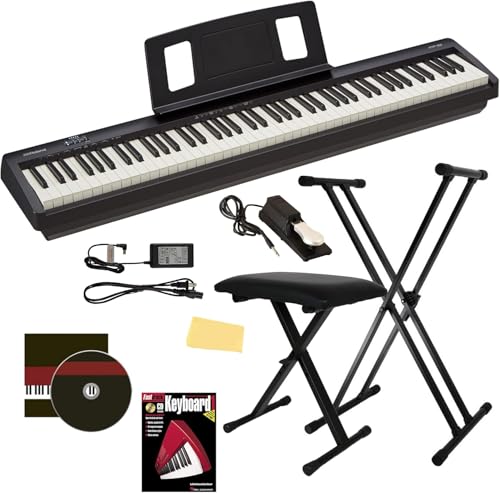 Roland FP-10 88-Key Bundle Roland's PHA-4 Standard action with escapement is the best key feel available near this price, and escapement is the subtle notch a real grand gives you at the bottom of a soft key press. | The most realistic key feel under the step-up tier | 9.3/10 | $599.99View on Amazon #ad · price as of October 27, 2026 · how this is funded |
| 2 | 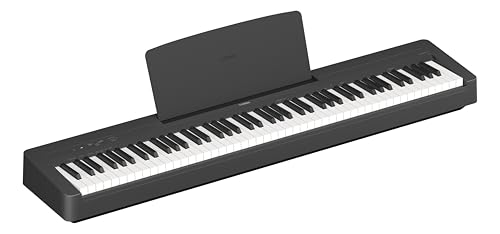 Yamaha P-145 88-Key Digital Piano Fully weighted hammer action in the smallest, lightest body Yamaha makes it in. If the student has a piano teacher, this is the point where the instrument stops being the limiting factor. | Students with a piano teacher | 9.2/10 | $529.99View on Amazon #ad · price as of October 27, 2026 · how this is funded |
| 3 |  Alesis Recital Play 88-Key Bundle The cheapest way to get 88 semi-weighted keys under a student's hands. It is not a piano action, but it is a full keyboard range, and range is the thing a 61-key board cannot fake. | Full 88-key range on the smallest budget | 8.4/10 | $189.00View on Amazon #ad · price as of October 27, 2026 · how this is funded |
| 4 |  Casio CDP-S160 Bundle Fully weighted scaled hammer action at the bottom of the weighted-piano market. Fewer voices and a plainer cabinet than the Privia, with the action that matters left intact. | The cheapest genuinely weighted 88 | 8.7/10 | $599.99View on Amazon #ad · price as of October 27, 2026 · how this is funded |
Scores are our own editorial fit rating from published specifications — the rubric is on our methodology page. They are not test results; we have not played these instruments.
The three actions
| Action | How it works | Feels like | Suits |
|---|---|---|---|
| Unweighted / synth | A spring returns the key; nothing resists the press | Light and fast, like a computer key | Organ and synth players; portable keyboards |
| Semi-weighted | Stiffer springs, sometimes small added weights | More substantial than a synth, still springy at the bottom | Stage keyboards, budget 88-key boards, producers |
| Fully weighted / hammer | A physical hammer mechanism with real mass, usually graded heavier in the bass | Like an acoustic piano — momentum, not just resistance | Anyone learning piano |
The difference between semi-weighted and hammer action is momentum. A spring pushes back; a hammer has to be accelerated and then settles. That distinction is what fingers learn from, and it is why springs do not substitute.
Why it matters for a student
Piano technique is partly a physical skill built against resistance. Controlling volume means controlling how fast the hammer is thrown, which the fingers learn by feel over months. On an unweighted keyboard there is no hammer and nothing to learn against.
The consequence is concrete rather than theoretical. A student who practices for a year on unweighted keys, then sits at an acoustic piano for a lesson or an exam, finds it heavy and unresponsive. The dynamics they had learned do not come out, and quiet passages simply fail to sound. It is recoverable in a few months of adjustment, and it is entirely avoidable.
Graded, and why it exists
On an acoustic piano the bass strings are longer and heavier, so their hammers are bigger and the keys feel heavier at the bottom end. Graded hammer action reproduces that gradient, so the left hand meets more resistance than the right.
This is a refinement rather than a threshold. Any hammer action is dramatically better than none, and graded is better again. Look for manufacturer designations rather than adjectives: Yamaha GHS or GHC, Roland PHA-4, Casio Smart Scaled Hammer.
The marketing words to be careful with
“Touch sensitive” is not the same as “weighted”. Touch sensitivity means the instrument responds to how hard you play; weighting is about physical resistance. A keyboard can be touch sensitive and completely unweighted, and many are.
“Hammer-action feel” and “piano-style keys” are frequently applied to semi-weighted instruments. If the listing does not name an actual action mechanism, assume it is not a hammer action.
When semi-weighted is genuinely the right answer
- A very young child. Hammer action can be genuinely heavy for a five- or six-year-old, and a light action lets them play without straining. Teachers differ on this and the argument is real on both sides.
- An instrument that has to be carried regularly. Hammer mechanisms are heavy by design. A semi-weighted 88 weighs substantially less than a weighted one.
- Production and songwriting rather than piano study. If the goal is programming parts and playing synth lines, hammer action is actively unhelpful.
- Budget, with the full 88-key range as the priority. A semi-weighted 88 gives complete range for less money. It is a real trade rather than a mistake.
The straight answer
If the student is learning piano and there is a teacher: fully weighted, and it is worth stretching the budget for. If the student is exploring, is very young, or the instrument needs to move around: semi-weighted or unweighted is fine, and the money is better spent on a good method book and the right bench height.
If the student is already on a semi-weighted instrument and the question is whether to replace it, when to upgrade a digital piano sets out the four signals that make the action the actual limiting factor — and the two much cheaper fixes that usually come first.
The picks, in full
Every card below is written from the published specification and the manufacturer’s own documentation. We have not played these instruments — see how we work for exactly what that means and what we do instead.
Our top pick · The most realistic key feel under the step-up tier
Roland FP-10 88-Key Bundle
Roland's PHA-4 Standard action with escapement is the best key feel available near this price, and escapement is the subtle notch a real grand gives you at the bottom of a soft key press.
What works
- PHA-4 Standard action with escapement and ivory-feel key tops
- Bundle includes stand, bench, sustain pedal and instructional material
- SuperNATURAL piano engine is a class above most rivals at this size
What to know
- Onboard speakers are small; the sound rewards headphones
- Heavier than the lightest 88-key boards
- Keys
- 88
- Action
- PHA-4 Standard with escapement
- Bundle
- Stand, bench, sustain pedal (per listing)
#ad · price as of October 27, 2026 · how this is funded
Specs read from the manufacturer or retailer listing on 2026-09-07. Our fit score: 9.3/10.
Pick 2 · Students with a piano teacher
Yamaha P-145 88-Key Digital Piano
Fully weighted hammer action in the smallest, lightest body Yamaha makes it in. If the student has a piano teacher, this is the point where the instrument stops being the limiting factor.
What works
- Graded hammer action — heavier in the bass, lighter in the treble, like an acoustic piano
- Genuinely compact and light for a full weighted 88
- Bluetooth and a headphone socket for silent practice
What to know
- Deliberately minimal control panel — most settings need a key combination
- Stand and bench are usually extra
- Keys
- 88
- Action
- Graded hammer standard (weighted)
- Bluetooth
- Yes (per listing)
#ad · price as of October 27, 2026 · how this is funded
Specs read from the manufacturer or retailer listing on 2026-09-07. Our fit score: 9.2/10.
Pick 3 · Full 88-key range on the smallest budget
Alesis Recital Play 88-Key Bundle
The cheapest way to get 88 semi-weighted keys under a student's hands. It is not a piano action, but it is a full keyboard range, and range is the thing a 61-key board cannot fake.
What works
- All 88 keys, so no repertoire is out of reach for range reasons
- Semi-weighted action gives some resistance, unlike a synth-action keyboard
- Bundle typically includes stand, bench and headphones
What to know
- Semi-weighted is not hammer action — a student moving to an acoustic piano will notice
- Built-in speakers are modest; headphones or an external speaker help a lot
- Keys
- 88
- Action
- Semi-weighted
- Hammer action
- No
- Bundle
- Stand, bench, headphones (per listing)
#ad · price as of October 27, 2026 · how this is funded
Specs read from the manufacturer or retailer listing on 2026-09-07. Our fit score: 8.4/10.
Pick 4 · The cheapest genuinely weighted 88
Casio CDP-S160 Bundle
Fully weighted scaled hammer action at the bottom of the weighted-piano market. Fewer voices and a plainer cabinet than the Privia, with the action that matters left intact.
What works
- Scaled hammer action rather than semi-weighted
- Compact and light enough to move for storage
- Bundle typically covers the stand, bench and pedal
What to know
- Small internal speakers
- Sparse voice list compared with its Yamaha counterpart
- Keys
- 88
- Action
- Scaled hammer action
- Bundle
- Stand, bench, pedal (per listing)
#ad · price as of October 27, 2026 · how this is funded
Specs read from the manufacturer or retailer listing on 2026-09-07. Our fit score: 8.7/10.
Questions people actually ask
Do beginners need weighted keys?
Not to start, but yes if the goal is playing the piano. Weighted keys build finger strength and control against real resistance, and a student who practices for a year on unweighted keys finds an acoustic piano heavy and unresponsive when they finally sit at one.
What are semi-weighted keys?
Keys with stiffer springs and sometimes small added weights, giving more resistance than a synth action but none of a hammer's momentum. Better than unweighted, and not a substitute for hammer action if the goal is piano study.
Is touch sensitive the same as weighted?
No, and the two are confused constantly. Touch sensitivity means the instrument responds to how hard you press. Weighting is about physical resistance in the key itself. Many keyboards are touch sensitive and entirely unweighted.
Are weighted keys too heavy for a young child?
Sometimes. A five- or six-year-old may genuinely struggle with a full hammer action, and teachers differ on whether to start light and progress or start correctly. If the child is straining rather than playing, a lighter action for a year is a defensible choice.
Sources
We have not played these instruments, so citation is our evidence. Everything above traces back to one of these, on the date shown.