Piano bench height, and why it matters
A child sitting too low drops their wrists below the keys, and a dropped wrist is a technique problem a teacher then spends months undoing.
By Stephen V. · Writes Reed & Rosin · last verified
The short answer
Set the bench so the forearms are level with the floor when the hands rest on the keys, with the elbows slightly in front of the body. For a child whose feet do not reach the floor, add a footstool: dangling feet cause the whole body to slide forward and the wrists to collapse.
Some links on this page earn us a commission at no extra cost to you. It does not change which instrument we recommend, and it does not change the order. We also earn nothing when the honest answer is “rent it” — and we still say so. Full disclosure.
Quick picks
| # | Product | Best for | Score | Price |
|---|---|---|---|---|
| 1 | 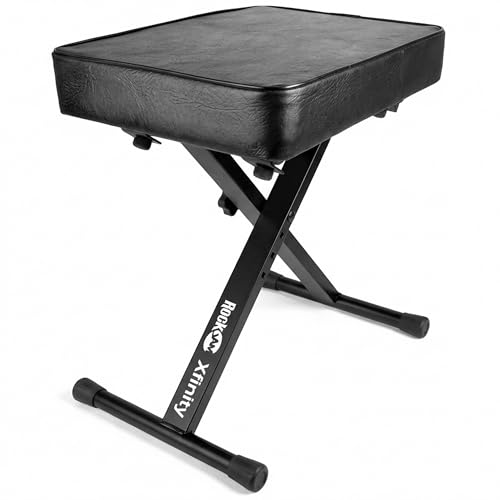 RockJam RJKBB100 Adjustable Bench Adjustable height is the entire point. A child at a fixed-height bench sits too low, drops their wrists, and builds a technique problem their teacher then spends months undoing. | Getting a child's wrists level | 8.2/10 | $39.99View on Amazon #ad · price as of October 27, 2026 · how this is funded |
| 2 |  M-Audio SP-2 Sustain Pedal A piano-style sustain pedal with a polarity switch, so it works with any keyboard. The plastic footswitch that ships with cheap keyboards slides across the floor and teaches bad pedal habits. | Replacing the plastic footswitch | 8.9/10 | $25.00View on Amazon #ad · price as of October 27, 2026 · how this is funded |
Scores are our own editorial fit rating from published specifications — the rubric is on our methodology page. They are not test results; we have not played these instruments.
Why this is worth a page
Bench height is the cheapest technique intervention available and one of the most commonly ignored. It is not about comfort. Sitting at the wrong height forces the wrist into a position that limits what the fingers can do, and it does so invisibly — the student experiences it as “this passage is hard” rather than “I am sitting too low”.
Setting the height
- 1
Sit on the front half of the bench
Not perched on the edge and not sitting back against nothing. The front half, with the feet able to reach the pedals or the floor. Sitting too far back pulls the arms into a stretch.
- 2
Rest the hands on the keys
Fingers curved as if holding a small ball, hands on the white keys in the middle of the instrument, shoulders relaxed and down.
- 3
Check the forearms are level with the floor
This is the target. Looking from the side, the forearm should run roughly parallel to the ground from elbow to wrist. If the wrist drops below the elbow, the bench is too low. If it rises above, too high.
- 4
Check the elbows sit slightly in front of the body
Not tucked into the ribs and not reaching forward. Slightly ahead, hanging naturally. Elbows behind the torso means the bench is too close to the instrument.
- 5
Sort the feet
For an adult, flat on the floor. For a child whose feet dangle, add a footstool at a height that lets them rest flat with the knees at roughly a right angle. Dangling feet make the body slide forward and the wrists collapse.
The dropped wrist, and why teachers care so much
When the wrist falls below the level of the keys, the fingers have to reach upward to press. That changes which muscles do the work, reduces control over volume, and makes fast passages significantly harder. It is not a stylistic preference — it is a mechanical limit.
It is also a habit, which means it persists after the bench is fixed and has to be actively unlearned. Catching it in the first month costs nothing; catching it in year two costs months.
The footstool problem
A child sitting at a piano bench designed for an adult has their feet in mid-air. The body compensates by sliding forward to reach for stability, which drops the torso, which drops the wrists. Fixing the bench height alone does not solve it, because the feet still have nowhere to go.
Any stable box of the right height works. Purpose-made adjustable footstools exist and are pleasant to have; a sturdy step stool or a stack of books does the same job. The requirement is that it does not slide and it does not tip.
Why adjustable benches earn their premium
A fixed-height bench is correct for exactly one person at one size. A child grows, an adult and a child share the instrument, and a piano used by more than one person needs to change height between users.
Adjustable benches are inexpensive and they remove the excuse. The adjustment mechanism is usually a manual screw thread, which is slightly fiddly and entirely adequate for a change made a few times a week.
What about a chair?
A dining chair is a common substitute and a poor one, for a specific reason: it has a back, and a piano student should sit forward on the seat without leaning back. A chair back invites leaning, leaning changes the arm angle, and the whole geometry above collapses.
If a bench is genuinely not available, use a backless stool at the right height and accept that height is the compromise. But a bench is inexpensive, and it is a better use of money than almost any sound- related upgrade at this stage.
Bench height and pedalling are the same problem seen from two angles: a student sitting too high cannot keep a heel on the floor, and a heel that lifts cannot pedal in time with the hands. Our sustain pedal guide covers the foot position this geometry makes possible, and when a beginner actually needs a pedal at all.
The seat is only half of the geometry: a bench set perfectly under a keyboard that is four inches too high solves nothing. If the instrument is still sitting on a table, our keyboard stands guide has the published height ranges and which frame suits which keyboard.
All of this assumes a bench whose height can actually be set. If yours is a fixed-height stool or a dining chair, the arithmetic above has nowhere to go — our roundup of piano and keyboard benches covers the adjustment mechanisms that hold and the ones that slowly sink.
The picks, in full
Every card below is written from the published specification and the manufacturer’s own documentation. We have not played these instruments — see how we work for exactly what that means and what we do instead.
Our top pick · Getting a child's wrists level
RockJam RJKBB100 Adjustable Bench
Adjustable height is the entire point. A child at a fixed-height bench sits too low, drops their wrists, and builds a technique problem their teacher then spends months undoing.
What works
- Height adjusts as the child grows, which a fixed bench cannot
- Padded top makes a 30-minute practice session bearable
What to know
- Adjustment mechanism is manual and slightly fiddly
- Not built for the weight of an adult using it daily for years
- Adjustable
- Yes
- Padded
- Yes
#ad · price as of October 27, 2026 · how this is funded
Specs read from the manufacturer or retailer listing on 2026-09-07. Our fit score: 8.2/10.
Pick 2 · Replacing the plastic footswitch
M-Audio SP-2 Sustain Pedal
A piano-style sustain pedal with a polarity switch, so it works with any keyboard. The plastic footswitch that ships with cheap keyboards slides across the floor and teaches bad pedal habits.
What works
- Piano-shaped and heavy enough to stay put under a foot
- Polarity switch means it behaves correctly with any brand
What to know
- On/off only — no half-pedaling, which advanced repertoire eventually wants
- Type
- Piano-style sustain pedal
- Polarity switch
- Yes
- Half-pedal support
- No
#ad · price as of October 27, 2026 · how this is funded
Specs read from the manufacturer or retailer listing on 2026-09-07. Our fit score: 8.9/10.
Questions people actually ask
How high should a piano bench be?
High enough that the forearms are level with the floor when the hands rest on the keys, with the elbows hanging slightly in front of the body. If the wrists drop below the elbows the bench is too low, which is by far the more common error.
What if my child's feet do not reach the floor?
Use a footstool. Dangling feet make a child slide forward for stability, which drops the torso and collapses the wrists — so fixing the bench height alone does not solve it. Any stable, non-slip box of roughly the right height works.
Why do piano teachers care about wrist position?
Because a dropped wrist mechanically limits what the fingers can do: it changes which muscles work, reduces control over volume, and makes fast passages harder. It is also a habit that persists after the seating is fixed and has to be actively unlearned.
Can I use a normal chair instead of a piano bench?
Poorly. A chair with a back invites leaning back, which changes the arm angle and undoes the correct geometry. A backless stool at the right height is a workable substitute; an adjustable bench is inexpensive and better.
Sources
We have not played these instruments, so citation is our evidence. Everything above traces back to one of these, on the date shown.