How many keys does a beginner need?
A short question with a genuinely conditional answer, and the condition is whether there is a piano teacher in the picture.
By Stephen V. · Writes Reed & Rosin · last verified
The short answer
61 keys covers an entire first-year method book and most of a second, and suits a young child, a tight budget or an instrument that must be stored. Choose 88 when a piano teacher is involved, because they will assign repertoire that runs off a 61-key board within a couple of years.
Some links on this page earn us a commission at no extra cost to you. It does not change which instrument we recommend, and it does not change the order. We also earn nothing when the honest answer is “rent it” — and we still say so. Full disclosure.
Quick picks
| # | Product | Best for | Score | Price |
|---|---|---|---|---|
| 1 |  Yamaha 61-Key Touch-Sensitive Portable Keyboard Touch sensitivity is the spec that matters at this price: without it, pressing harder does nothing, and a child learning dynamics on a non-sensitive keyboard is learning a habit they will have to unlearn. | A first keyboard that teaches dynamics | 9.0/10 | $199.99View on Amazon #ad · price as of October 27, 2026 · how this is funded |
| 2 |  Casio Casiotone CT-S1 A deliberately stripped-back 61-key board with a serious grand piano voice and no menu-diving. Fewer sounds than its rivals, and the ones it has are better. | Beginners who want a good piano sound, not 700 sounds | 8.8/10 | $219.99View on Amazon #ad · price as of October 27, 2026 · how this is funded |
| 3 | 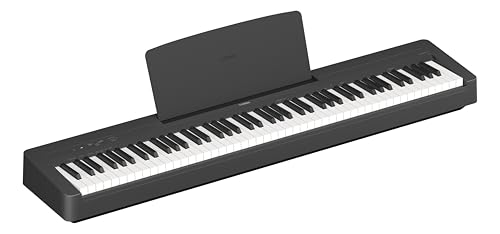 Yamaha P-145 88-Key Digital Piano Fully weighted hammer action in the smallest, lightest body Yamaha makes it in. If the student has a piano teacher, this is the point where the instrument stops being the limiting factor. | Students with a piano teacher | 9.2/10 | $529.99View on Amazon #ad · price as of October 27, 2026 · how this is funded |
| 4 |  Alesis Recital Play 88-Key Bundle The cheapest way to get 88 semi-weighted keys under a student's hands. It is not a piano action, but it is a full keyboard range, and range is the thing a 61-key board cannot fake. | Full 88-key range on the smallest budget | 8.4/10 | $189.00View on Amazon #ad · price as of October 27, 2026 · how this is funded |
Scores are our own editorial fit rating from published specifications — the rubric is on our methodology page. They are not test results; we have not played these instruments.
The comparison
| Keys | Octaves | What you can play | Who it suits |
|---|---|---|---|
| 49 | 4 | Early method-book pieces only; runs out within months | Nobody learning piano. Fine as a controller for music production |
| 61 | 5 | The whole of a first-year method book and most of a second | Young children, tight budgets, instruments that must be stored |
| 76 | 6+ | Most intermediate repertoire, with occasional transposition | Gigging players who need portability; an odd choice for a student |
| 88 | 7+ | Everything written for piano, with no compromises | Any student with a piano teacher, and any adult returning to piano |
Why 49 keys is a false economy
It looks like a keyboard and it saves a small amount of money, and a student outgrows it within months rather than years. Four octaves is not enough range for both hands to play in their natural positions on anything but the simplest early pieces — the left hand ends up crammed against the bottom of the instrument.
49-key instruments have a legitimate purpose as MIDI controllers for music production, where the software supplies the range. For learning to play, they are the wrong tool.
What 61 keys genuinely covers
More than people expect. A full first-year method book fits comfortably, and so does most of a second. Both hands have room to play in their natural positions, and the pieces a beginner works on rarely reach the extremes of the keyboard.
The first real constraints appear in the second or third year: a piece whose left hand goes lower than the board reaches, or a passage that climbs off the top. At that point the instrument is genuinely limiting.
The question that settles it
Is there a piano teacher, or will there be?
If yes, buy 88 weighted keys now. The teacher will assign repertoire that needs the range and the resistance, and the student will sit at an acoustic piano in lessons and exams. Buying 61 keys first means buying twice.
If no — a child exploring, an adult experimenting, a household with no lesson plans —61 keys is the right call. It costs less, takes less space, and covers everything that will happen in the first year or two.
The other decision, made at the same time
Key count and key weighting are separate specifications, and they get conflated constantly. There are 61-key instruments with weighted keys and 88-key instruments without them.
In practice the two travel together for a reason: manufacturers build 61-key boards for portability and 88-key boards for piano study, so weighting follows. But check both individually rather than assuming — the weighted-keys page covers the second half of the decision.
The storage question nobody asks
An 88-key digital piano is roughly four and a half feet wide. That is furniture. It needs a permanent place with a stand and a bench, and moving it for a dinner party is not a five-second job.
A 61-key portable is about three feet and can genuinely live in a cupboard between sessions. That sounds trivial and it is not: an instrument with no permanent home gets set up less often, and set up less often means played less often. If there is no space for an 88, the 61 that gets played beats the 88 that stays in its box.
For an adult asking this question about themselves rather than about a child, the range answer is usually 88 and the reasoning is different: an adult has stopped growing, so the instrument is a once purchase rather than a staging post. Digital pianos for adult beginners takes that case on its own terms.
The picks, in full
Every card below is written from the published specification and the manufacturer’s own documentation. We have not played these instruments — see how we work for exactly what that means and what we do instead.
Our top pick · A first keyboard that teaches dynamics
Yamaha 61-Key Touch-Sensitive Portable Keyboard
Touch sensitivity is the spec that matters at this price: without it, pressing harder does nothing, and a child learning dynamics on a non-sensitive keyboard is learning a habit they will have to unlearn.
What works
- Touch-sensitive keys, so playing harder is actually louder
- 61 keys covers everything in a beginner method book
- Ships with the power adapter and music rest — both commonly missing at this price
What to know
- Keys are unweighted; a player heading toward classical piano will need weighted keys eventually
- 61 keys runs out of room in intermediate repertoire
- Keys
- 61
- Touch sensitive
- Yes
- Weighted action
- No
- Included
- Power adapter, music rest (per listing)
#ad · price as of October 27, 2026 · how this is funded
Specs read from the manufacturer or retailer listing on 2026-09-07. Our fit score: 9.0/10.
Pick 2 · Beginners who want a good piano sound, not 700 sounds
Casio Casiotone CT-S1
A deliberately stripped-back 61-key board with a serious grand piano voice and no menu-diving. Fewer sounds than its rivals, and the ones it has are better.
What works
- Front panel has almost no clutter — a child can turn it on and play
- The core piano and electric piano voices are a step above the category
- Runs on batteries and is light enough to move room to room
What to know
- Far fewer voices and rhythms than a similarly priced Yamaha
- Unweighted keys
- Keys
- 61
- Touch sensitive
- Yes
- Weighted action
- No
- Battery powered
- Yes
#ad · price as of October 27, 2026 · how this is funded
Specs read from the manufacturer or retailer listing on 2026-09-07. Our fit score: 8.8/10.
Pick 3 · Students with a piano teacher
Yamaha P-145 88-Key Digital Piano
Fully weighted hammer action in the smallest, lightest body Yamaha makes it in. If the student has a piano teacher, this is the point where the instrument stops being the limiting factor.
What works
- Graded hammer action — heavier in the bass, lighter in the treble, like an acoustic piano
- Genuinely compact and light for a full weighted 88
- Bluetooth and a headphone socket for silent practice
What to know
- Deliberately minimal control panel — most settings need a key combination
- Stand and bench are usually extra
- Keys
- 88
- Action
- Graded hammer standard (weighted)
- Bluetooth
- Yes (per listing)
#ad · price as of October 27, 2026 · how this is funded
Specs read from the manufacturer or retailer listing on 2026-09-07. Our fit score: 9.2/10.
Pick 4 · Full 88-key range on the smallest budget
Alesis Recital Play 88-Key Bundle
The cheapest way to get 88 semi-weighted keys under a student's hands. It is not a piano action, but it is a full keyboard range, and range is the thing a 61-key board cannot fake.
What works
- All 88 keys, so no repertoire is out of reach for range reasons
- Semi-weighted action gives some resistance, unlike a synth-action keyboard
- Bundle typically includes stand, bench and headphones
What to know
- Semi-weighted is not hammer action — a student moving to an acoustic piano will notice
- Built-in speakers are modest; headphones or an external speaker help a lot
- Keys
- 88
- Action
- Semi-weighted
- Hammer action
- No
- Bundle
- Stand, bench, headphones (per listing)
#ad · price as of October 27, 2026 · how this is funded
Specs read from the manufacturer or retailer listing on 2026-09-07. Our fit score: 8.4/10.
Questions people actually ask
Is 61 keys enough for a beginner?
Yes, for the whole of a first-year method book and most of a second. It becomes limiting in the second or third year, when repertoire starts using the ends of the keyboard. If a piano teacher is involved from the start, buy 88 keys instead.
Do I need 88 keys to learn piano?
Not to start, but yes if you intend to study piano properly with a teacher. The range and the weighted action are both things a teacher assumes, and buying 61 keys first means buying twice.
Is a 49 key keyboard good for beginners?
No. Four octaves is not enough range for both hands to sit in their natural positions on anything beyond the simplest pieces, and a student outgrows it within months. 49-key instruments are useful as MIDI controllers, not as learning instruments.
What is the difference between 61 and 88 key keyboards?
Two and a bit extra octaves of range, mostly in the bass. In practice 88-key instruments are also usually weighted and 61-key instruments usually are not, but those are separate specifications and should be checked separately.