Digital piano versus acoustic piano
This decision is usually framed as a question about sound. For a household with a beginner in it, almost every term that matters is actually about running cost and noise.
By Stephen V. · Writes Reed & Rosin · last verified
The short answer
For a beginner, buy a weighted digital piano. An acoustic piano needs tuning roughly twice a year forever, cannot be practised through headphones, and costs real money to move — and a free upright with a cracked soundboard is the most expensive piano in this comparison.
Some links on this page earn us a commission at no extra cost to you. It does not change which instrument we recommend, and it does not change the order. We also earn nothing when the honest answer is “rent it” — and we still say so. Full disclosure.
Quick picks
| # | Product | Best for | Score | Price |
|---|---|---|---|---|
| 1 | 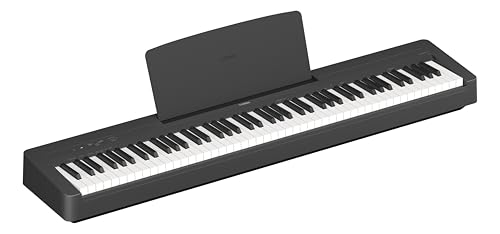 Yamaha P-145 88-Key Digital Piano Fully weighted hammer action in the smallest, lightest body Yamaha makes it in. If the student has a piano teacher, this is the point where the instrument stops being the limiting factor. | Students with a piano teacher | 9.2/10 | $529.99View on Amazon #ad · price as of October 5, 2026 · how this is funded |
| 2 | 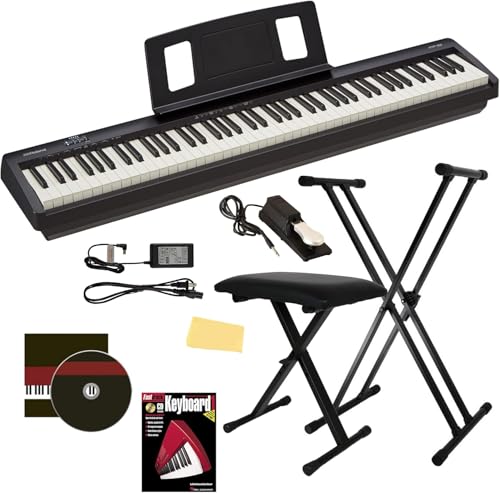 Roland FP-10 88-Key Bundle Roland's PHA-4 Standard action with escapement is the best key feel available near this price, and escapement is the subtle notch a real grand gives you at the bottom of a soft key press. | The most realistic key feel under the step-up tier | 9.3/10 | $599.99View on Amazon #ad · price as of October 5, 2026 · how this is funded |
| 3 |  Casio Privia PX-S1100 Bundle Casio's slimmest weighted 88, with a smart hammer action and simulated ebony and ivory key texture. Choose it when the piano has to live in a room that is also used for something else. | Weighted keys in a small apartment | 9.0/10 | $779.99View on Amazon #ad · price as of October 5, 2026 · how this is funded |
| 4 |  Audio-Technica ATH-M20x Closed-back, wired, and flat enough that a student hears what they actually played rather than a flattered version of it. Wired matters: Bluetooth latency makes a digital piano unplayable. | Silent digital-piano practice | 9.0/10 | $59.00View on Amazon #ad · price as of October 5, 2026 · how this is funded |
Scores are our own editorial fit rating from published specifications — the rubric is on our methodology page. They are not test results; we have not played these instruments.
Three different questions wear the same clothes
People ask this question meaning one of three things, and the answers diverge. “Keyboard or digital piano” is a question about key count and action, and we answer it on its own page. “Digital piano or acoustic piano” — this page — is a question about ownership: what the thing costs to keep, where it can live, and when it can be played. And “should I accept my aunt’s free upright” is a question about repair bills, which gets its own section below because it is the single most expensive mistake in this whole topic.
The honest summary before the detail: an acoustic piano is a better instrument and a worse purchase for most beginners. Nothing digital quite reproduces the sound of strings in a wooden box in a room. But a beginner spends their first two years on scales, five-finger exercises and simple pieces, and none of that is limited by a good digital action. What does limit it is whether they can practise at nine at night without waking a sibling.
The running-cost comparison nobody puts in the brochure
| Acoustic piano | Digital piano | |
|---|---|---|
| Tuning | Required roughly twice a year, forever, by a visiting technician — and a piano that has sat untuned for years may need several visits to bring up to pitch | Never. There is nothing to tune |
| Humidity | Wood and a cast-iron frame under tension; swings crack soundboards and loosen tuning | No effect worth managing |
| Moving it | Specialist movers, stairs priced separately, and it needs tuning again after the move | Two people, or one person for the slim models |
| Silent practice | Not possible without an aftermarket silent system | Headphone socket as standard |
| Volume control | The lid and the player's hands | A volume knob |
| Depreciation | Enormous at the bottom of the market — unplayable uprights are given away free | Steady, like any electronic device |
Figures and requirements here are structural rather than quoted — tuning and moving costs vary too much by region to publish a number we would stand behind. The point is the column each row falls in, not the dollar amount.
The free piano problem
Every town has unplayable uprights being offered free, and they are offered free for a reason: at the bottom of this market an acoustic piano is a liability rather than an asset. Moving one costs real money, and a piano that has not been tuned in fifteen years may not hold pitch at all. If the soundboard is cracked, the pin block is loose or the strings are badly rusted, the repair exceeds the cost of a new weighted digital — frequently by several times.
That does not mean never take a free piano. It means never take one unseen. The check is: does every key produce a note, is the pitch roughly consistent across the keyboard, do the pins look tight rather than canted, and will a technician look at it before you pay to move it. A technician’s visit before the move is the cheapest insurance available in this entire decision. Our used instrument guide covers the same logic for the instruments that fit in a car.
What an acoustic piano genuinely gives you
Three things, and they are real. The sound of a struck string decaying in a room has a complexity no sample set fully carries, and it is more obvious the better the piano is. The action of a good acoustic responds to small gradations of touch in a way that even the best digital actions approximate rather than match. And an acoustic piano is a permanent object in a house — it sits there, tuned and ready, and a child walks past it and plays four notes, which is a surprisingly large part of how children end up practising at all.
Where that adds up to “buy the acoustic”: a student past about the fourth year of lessons, working on repertoire where tone control is the actual subject of the lesson; a household with a room the piano can own; and a teacher who has asked for it. Below that, the money buys more playing on a digital.
Ask the teacher, not the showroom
A piano teacher will tell you plainly whether a student’s current instrument is the thing holding them back, and the answer in the first two years is almost always no. The honest version of this question is not “which is better” but “is my instrument the limiting factor yet” — and the person who hears the student play every week is the only one who can answer it.
If the answer is digital, what to look for
The specification that carries almost all of the difference is the action. A hammer action has a physical hammer that falls, which is why it is heavier in the bass than the treble; a semi-weighted keyboard uses springs and feels identical all the way up. A student moving between a digital piano at home and an acoustic at a lesson will notice that difference in the first bar. Escapement — the faint notch near the bottom of a slow key press — is the next step up, and only one of the instruments below publishes it.
The three picks here are the weighted 88-key instruments we would put a piano student on. Each is covered in full on the digital piano roundup, with an adult-specific version of the same shortlist on the adult beginner page. The fourth item is the headphones, because headphone practice is the entire structural advantage a digital piano has and it does not work over Bluetooth.
One more honest note on cost. A weighted digital piano plus a stand, bench, pedal and headphones is not a cheap purchase, and the comparison people usually make — digital piano against a free upright — is not the comparison that matters. The comparison that matters is against a playable acoustic, tuned twice a year, moved once. Against that, the digital wins on cost for a beginner by a wide margin, and it is the only one of the two that can be played silently at night.
The picks, in full
Every card below is written from the published specification and the manufacturer’s own documentation. We have not played these instruments — see how we work for exactly what that means and what we do instead.
Our top pick · Students with a piano teacher
Yamaha P-145 88-Key Digital Piano
Fully weighted hammer action in the smallest, lightest body Yamaha makes it in. If the student has a piano teacher, this is the point where the instrument stops being the limiting factor.
What works
- Graded hammer action — heavier in the bass, lighter in the treble, like an acoustic piano
- Genuinely compact and light for a full weighted 88
- Bluetooth and a headphone socket for silent practice
What to know
- Deliberately minimal control panel — most settings need a key combination
- Stand and bench are usually extra
- Keys
- 88
- Action
- Graded hammer standard (weighted)
- Bluetooth
- Yes (per listing)
#ad · price as of October 5, 2026 · how this is funded
Specs read from the manufacturer or retailer listing on 2026-09-07. Our fit score: 9.2/10.
Pick 2 · The most realistic key feel under the step-up tier
Roland FP-10 88-Key Bundle
Roland's PHA-4 Standard action with escapement is the best key feel available near this price, and escapement is the subtle notch a real grand gives you at the bottom of a soft key press.
What works
- PHA-4 Standard action with escapement and ivory-feel key tops
- Bundle includes stand, bench, sustain pedal and instructional material
- SuperNATURAL piano engine is a class above most rivals at this size
What to know
- Onboard speakers are small; the sound rewards headphones
- Heavier than the lightest 88-key boards
- Keys
- 88
- Action
- PHA-4 Standard with escapement
- Bundle
- Stand, bench, sustain pedal (per listing)
#ad · price as of October 5, 2026 · how this is funded
Specs read from the manufacturer or retailer listing on 2026-09-07. Our fit score: 9.3/10.
Pick 3 · Weighted keys in a small apartment
Casio Privia PX-S1100 Bundle
Casio's slimmest weighted 88, with a smart hammer action and simulated ebony and ivory key texture. Choose it when the piano has to live in a room that is also used for something else.
What works
- Remarkably slim body for a fully weighted 88-key instrument
- Textured key tops give grip that plain plastic does not
- Battery operation is possible, which is rare in this class
What to know
- Touch-sensitive panel controls are easy to trigger by accident
- Costs more than the equivalent-feeling but bulkier competition
- Keys
- 88
- Action
- Smart Scaled Hammer Action
- Key tops
- Simulated ebony and ivory
#ad · price as of October 5, 2026 · how this is funded
Specs read from the manufacturer or retailer listing on 2026-09-07. Our fit score: 9.0/10.
Pick 4 · Silent digital-piano practice
Audio-Technica ATH-M20x
Closed-back, wired, and flat enough that a student hears what they actually played rather than a flattered version of it. Wired matters: Bluetooth latency makes a digital piano unplayable.
What works
- Wired, so there is zero latency between key and sound
- Closed back keeps the practice inside the room
- Fairly neutral tuning — the piano sounds like the piano
What to know
- Fixed cable cannot be replaced when it fails
- Clamping force is firm for a small head at first
- Type
- Closed-back, over-ear
- Connection
- Wired, 3.5 mm with 6.3 mm adapter
- Detachable cable
- No
#ad · price as of October 5, 2026 · how this is funded
Specs read from the manufacturer or retailer listing on 2026-09-07. Our fit score: 9.0/10.
Questions people actually ask
Is a digital piano good enough for a beginner?
Yes. A beginner's first two years are scales, five-finger exercises and simple repertoire, none of which is limited by a good weighted digital action. What does limit progress is practice frequency, and a digital piano with a headphone socket can be played at times an acoustic cannot.
How often does an acoustic piano need tuning?
Roughly twice a year, indefinitely, by a visiting technician. A piano that has gone years without tuning may need several visits to bring back up to pitch, and in humid or very dry rooms it will drift faster. A digital piano has nothing to tune.
Should I accept a free upright piano?
Only after someone has looked at it. Free pianos are free because moving one costs real money and the repairs can exceed the cost of a new weighted digital. Check that every key sounds, that pitch is roughly consistent, and have a technician see it before you pay a mover.
Can you practice an acoustic piano with headphones?
Not without an aftermarket silent system fitted, which is a specialist job and not cheap. Headphone practice is the structural advantage a digital piano has, and for a household with a beginner and thin walls it is usually the deciding term.
When is an acoustic piano the right choice?
When a student is several years in and working on repertoire where tone control is the subject of the lesson, when there is a room the piano can occupy permanently, and when the teacher has asked for it. Below that, the same money buys a better experience on a digital instrument.
Sources
We have not played these instruments, so citation is our evidence. Everything above traces back to one of these, on the date shown.