Guitar cases and gig bags: what a first guitar actually needs
A case is the accessory most likely to decide whether a beginner keeps playing, and the one almost nobody budgets for. The right answer depends on one question: where does this guitar go?
By Stephen V. · Writes Reed & Rosin · last verified
The short answer
Buy a padded gig bag with backpack straps if the guitar travels to lessons, a basic padded bag if it stays home, and a rigid case only if the guitar rides in a car, flies, or is worth more than the case. Padding depth matters more than brand.
Some links on this page earn us a commission at no extra cost to you. It does not change which instrument we recommend, and it does not change the order. We also earn nothing when the honest answer is “rent it” — and we still say so. Full disclosure.
Quick picks
| # | Product | Best for | Score | Price |
|---|---|---|---|---|
| 1 |  Gator Cases 4G-MiZone Series Gig Bag for Acoustic Guitars (GB-4G-ACOUSTIC) The bag to buy if the guitar leaves the house every week. Gator's 4G series is the step where a gig bag stops being a dust cover and starts being protection: thick padding, a rigid-backed panel over the body, and backpack straps a child can actually carry a dreadnought in. | A dreadnought that gets carried to weekly lessons | 9.0/10 | $84.99View on Amazon #ad · price as of October 31, 2026 · how this is funded |
| 2 |  Gator Cases 4G-MiZone Series Gig Bag for Electric Guitars (GB-4G-ELECTRIC) The same bag cut for a Stratocaster or Telecaster outline, which is the shape almost every beginner electric copies. Buy this rather than the acoustic version for an electric: the horns need the room and the neck needs the support in a different place. | A Strat- or Tele-shaped first electric | 8.9/10 | $84.99View on Amazon #ad · price as of October 31, 2026 · how this is funded |
| 3 |  CAHAYA Acoustic Guitar Gig Bag, 0.4 in Padding (CY0181) The budget bag that publishes its padding depth — 0.4 inches — which is the single number that tells you whether a cheap bag is a bag or a sleeve. Six pockets and a 40-to-42-inch fit range make it the most practical first purchase for a family that is not sure the guitar will stick. | A first guitar on the tightest budget | 7.9/10 | |
| 4 | 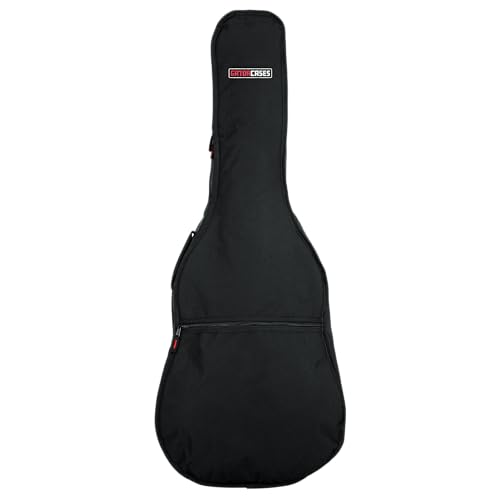 Gator Cases Foam Padded Acoustic Guitar Gig Bag (GBE-DREAD) The cheapest bag on this page we would still call a case. It is thin, and it is from a brand that publishes what it fits — up to 41.9 inches of guitar — which is more than most bags at this price will commit to. Buy it for a guitar that lives at home and occasionally moves rooms. | A guitar that stays home and needs dust and scratch cover | 7.6/10 | $29.99View on Amazon #ad · price as of October 31, 2026 · how this is funded |
| 5 |  Gator Cases Lightweight Polyfoam Guitar Case for Dreadnought Acoustics (GL-DREAD-12) The middle option almost nobody knows exists: a rigid polyfoam shell that holds its shape like a hard case but weighs closer to a bag. For a guitar that travels in a car, gets stacked with other gear, or belongs to a student who is hard on things, this is the sensible answer. | A guitar that rides in a car or gets stacked | 8.8/10 | $139.99View on Amazon #ad · price as of October 31, 2026 · how this is funded |
| 6 |  Crossrock Wooden Dreadnought Acoustic Guitar Case (CRW600DBK) A traditional arched-top wooden case with a lock and an interior compartment, listed as fitting Martin D-28, Taylor 210 and Yamaha FG dreadnought outlines. This is the only type of case here that genuinely protects a guitar left in a cold car or handed to anyone else. | A guitar worth more than the case, or one that travels | 8.5/10 | $139.99View on Amazon #ad · price as of October 31, 2026 · how this is funded |
| 7 |  Gator Cases 4G Series Gig Bag for Bass Guitars (GB-4G-BASS) A bass needs its own bag and this is the honest one: cut for Precision and Jazz outlines, which is what a first bass is shaped like, and long enough for a 34-inch scale. A guitar bag with a bass forced into it holds the neck nowhere near the headstock, which is exactly where the damage happens. | A full-scale Precision or Jazz style first bass | 8.7/10 | $84.99View on Amazon #ad · price as of October 31, 2026 · how this is funded |
Scores are our own editorial fit rating from published specifications — the rubric is on our methodology page. They are not test results; we have not played these instruments.
Buying this as a gift? Our gift guides re-explain these picks for the gifter. Wondering whether to wait for November? The Black Friday hub has the sourced record of what discounted last year and what did not.
The case is not an accessory. It is the reason the guitar gets played.
There is a pattern every guitar teacher recognizes. A student arrives for three weeks carrying the guitar in the cardboard box it was delivered in, or in a bag so thin the tuners press through the fabric. Then they stop carrying it, and then they stop coming. Not because they lost interest — because getting the guitar out of the house became a small ordeal, repeated weekly, and small ordeals win.
That is the honest argument for spending money on a case: it is the cheapest thing you can buy that changes how often the instrument is picked up and carried. It is also the accessory most likely to be left out of a first-guitar budget, because the guitar itself is the exciting purchase and a bag is a bag. If you are still choosing the instrument, start with our beginner acoustic roundup and come back to this page with a body shape in hand — it is the one thing you need to know before you buy a bag.
Three types, and what each one actually protects against
Almost all the confusion in this purchase comes from one word doing three jobs. “Case” is used for a fabric sleeve, for a rigid shell and for everything between, and the three are not alternatives to one another — they protect against different things.
| Type | What it is | Protects against | Fails at |
|---|---|---|---|
| Padded gig bag | Fabric shell with foam padding, shoulder or backpack straps | Scrapes, dust, rain, door frames, and the guitar being knocked off a stand | Impact. A bag will not save a guitar that is dropped on a hard edge or sat on |
| Polyfoam shell case | Rigid moulded foam shell with a fitted interior | Crushing, stacking, being leaned on, and movement inside the case on a journey | Space. It is bulky, and it dents permanently where wood would scuff |
| Wooden or ABS hard case | Rigid shell, latches, often a lock and a storage compartment | Nearly everything, including baggage handling and a cold car boot | Weight, price, and the chance a casual player picks the guitar up at all |
There is a fourth category sold as a case — an unpadded nylon sleeve. It keeps dust off and nothing else. We have not included one; a sleeve is not a case and a beginner who buys one thinks the guitar is protected when it is not.
The practical reading: the overwhelming majority of first guitars need a padded gig bag, a minority need a polyfoam shell, and almost none need a wooden hard case. The guitars that do need the hard case are the ones that fly, the ones that get handed to other people, and the ones that cost more than the case does.
How we chose these
We have not carried every one of these bags for a year, and we say so on every page — see how we research these picks. The criteria below are ones a published specification can actually answer, applied in this order.
| Criterion | What we required | Why it decides anything |
|---|---|---|
| Published fit | A stated body shape or a stated maximum guitar length | A bag that says 'fits most guitars' is telling you it was not cut for any of them. Fit is the whole product |
| Padding depth or shell type | A published padding figure, or a named rigid construction | It is the only spec that correlates with protection. Everything else in a bag listing is pockets |
| Carry method | Backpack straps on anything intended to leave the house | A single shoulder strap on a dreadnought is why kids stop carrying their own guitar |
| Neck and headstock support | A fitted neck area or a shaped interior, not a flat tube | The headstock is where almost all transport damage happens, because it is the heaviest unsupported part |
| Live availability | A real price and a purchasable state on the dated read | A recommendation you cannot buy is not a recommendation |
| Brand accountability | A case specialist, or a brand that publishes a model number | A model number means the product can be re-bought identically in two years. Generic bags change silently |
Fit scores on the cards are editorial judgments from these published criteria. They are not test results and we never emit them as rating data.
Match the bag to the body, not to the brand of guitar
This is where most returns come from. A guitar case is cut for a body outline, and those outlines have names. A beginner acoustic is almost always a dreadnought — the big square-shouldered shape — and a beginner electric is almost always a Stratocaster or Telecaster outline. If your guitar is one of those two things, a bag cut for it will fit snugly and hold the neck where it should.
| If the guitar is | Buy a bag cut for | Watch out for |
|---|---|---|
| A full-size beginner steel-string | Dreadnought | Nothing. This is the standard case and the easiest fit on the market |
| A classical or nylon-string guitar | Classical | A classical body is narrower and shorter than a dreadnought. A dreadnought bag leaves it loose |
| A 3/4-size or 'mini' guitar | The specific size, usually sold as 3/4 or mini | A full-size bag on a 3/4 guitar lets the instrument slide and the headstock hit the end |
| A Strat- or Tele-style electric | Electric | An acoustic bag has no room cut for the horns and holds the neck in the wrong place |
| An offset, V, Explorer or other odd shape | That specific model | Universal electric bags genuinely do not fit these. Check the maker's own list |
| A Precision or Jazz style bass | Bass | A bass is longer. A guitar bag leaves the headstock outside the padding, which is the one place it must not be |
Guitar lengths vary within a shape, which is why the specs on our cards publish the stated maximum length where a maker gives one. Measure from the end pin to the top of the headstock before ordering a close call.
Padding depth is the only number worth reading
Bag listings are mostly about pockets. Padding depth is the figure that tells you what the thing does, and the better makers publish it in fractions of an inch. Here is the honest translation, which no listing will give you.
| Padding | What it survives | Buy it for |
|---|---|---|
| Under a quarter inch | Dust, fingerprints, light scuffs | A guitar that lives on a stand and occasionally moves rooms |
| Around a third to a half inch | Weather, door frames, a tip-over onto carpet, a careful car journey | A guitar carried to weekly lessons — this is the useful range for most beginners |
| Three quarters of an inch and up, or a rigid shell | Being stacked, leaned on, or loaded into a car with other gear | A guitar that travels with equipment or belongs to a student who is hard on things |
Where a maker does not publish a padding figure, our product cards say 'Not published' rather than estimating one from the price. Two bags at the same price can differ by a factor of two here.
The pocket that matters, and the one that does not
One pocket big enough for a method book is worth more than six small ones, because the thing a student forgets is not picks — it is the book the lesson works from. The small pockets fill up with broken strings. If you are assembling the rest of the kit, our guitar starter-kit guide lists what should be in the bag before the first lesson.
Which one for which situation
| If this is you | Buy | Because |
|---|---|---|
| A dreadnought carried to a weekly lesson | The Gator 4G-MiZone acoustic bag | Backpack straps and real padding, cut for the shape your guitar almost certainly is |
| A Strat- or Tele-style first electric | The Gator 4G-MiZone electric bag | Same bag, cut for the horns and the shorter body. Do not substitute the acoustic version |
| The guitar stays home and needs dust cover | The Gator GBE-DREAD | Cheapest bag here from a case brand that still publishes what it fits |
| The budget is genuinely tight | The CAHAYA bag | It publishes its padding depth and carries a method book, which is more than most bags in this bracket |
| The guitar rides in a car with other gear | The Gator polyfoam GL-DREAD-12 | A rigid shell at a fraction of a hard case's weight. This is the under-known right answer |
| The guitar flies, or is worth real money | The Crossrock wooden case | Arched hard shell, a lock and a storage compartment. Nothing softer belongs on a plane |
| It is a bass, not a guitar | The Gator 4G bass bag | A 34-inch scale needs a longer bag. A guitar bag leaves the headstock unprotected |
What a case will not do: humidity
A closed case slows humidity change down. It does not stop it, and no bag of any price does. A solid-wood acoustic in a dry winter house will still lose moisture inside a latched hard case, just more slowly — which is useful, because it means a case plus a humidifier is a genuinely effective combination where a case alone is not.
Most beginner guitars are laminate rather than solid wood, which makes them far more tolerant of dry air; this is one of the few areas where a cheap guitar has an advantage. If the guitar is solid-topped, or the house drops below about 35 percent relative humidity in winter, read our guitar humidity guide before worrying about the case. A hard case is a better home for a humidifier than a gig bag, because the seal is better.
What actually damages a guitar in transit
It is worth knowing what the case is defending, because it is not evenly distributed. Four places take nearly all the damage, and three of them are at the same end of the instrument.
| Where | What happens | What prevents it |
|---|---|---|
| The headstock | The heaviest unsupported part swings on the end of a lever. A knock here snaps a neck or cracks the scarf joint | A fitted neck area and padding at the end of the bag. This is why a bag cut for the right length matters more than padding depth |
| The tuning machines | Bent shafts and chewed button edges, from the guitar resting face-down on its tuners | A gusset or raised panel over the headstock. Press on the bag over the tuners: if you feel them, so does everything else |
| The body edges and heel | Dings from door frames and from the guitar being set down on a corner | Padding depth, plain and simple. This is the damage a thin bag genuinely does not stop |
| The finish, everywhere | Haze and micro-scratches from grit inside a bag that has never been emptied | Emptying the bag. The commonest cause of scratches on a well-cased guitar is a loose capo in the main compartment |
Note what is not on this list: the strings and the bridge. Those are fine in any bag. The money is in supporting the neck and keeping the tuners off the floor.
Two habits save more guitars than any upgrade. Carry the bag with the headstock up rather than down, so a trip puts the body on the ground first. And never lean a bagged guitar against a wall at an angle: a soft case has no structure, so it slides, and a slide ends with the headstock hitting a skirting board. If there is nowhere to put the guitar down between the car and the lesson, that is the argument for a rigid case rather than a thicker bag.
What fails on a case, and when to replace it
Cases do not wear out in the places buyers inspect. The padding is usually fine for a decade; the hardware is not. The zip is the first failure on a gig bag, almost always at a corner where the slider is dragged around a tight radius, and a zip that has pulled away from the fabric cannot be repaired economically. Straps fail second, at the stitching rather than mid-strap. On a hard case it is the latches, and a latch that no longer holds is worse than no case at all, because the guitar will be carried as though it is secure.
A school- or rental-issued case is worth checking on this list before buying anything, because a program-owned case is often a decent one that simply needs its latch replaced. And a used case is a reasonable buy where a used guitar is not: there is nothing to go wrong inside it that cannot be seen, provided the interior is dry and the zip runs its full length without catching.
When not to buy a case at all
Two situations, and we would rather say so than sell into them.
The guitar already came with one. A large share of beginner acoustics and nearly every electric starter pack ship with a bag, and for a guitar that stays home it is often adequate. Check it before buying: press a thumb against the padding over where the tuners sit. If you can feel the tuners through it, the bag is a dust cover and worth replacing. If you cannot, keep it.
The guitar never leaves the room. A guitar on a stand in a bedroom is picked up far more often than one zipped into a bag, and that matters more in the first year than scratch protection does. A stand plus the bag it came with is a better purchase than a better bag, in that order.
The child-sized guitar problem
Most of the guitars this site recommends for children are 3/4-scale or smaller, and the case market mostly ignores them. There are far fewer bags cut for a 3/4 body, they sell out of colors and sizes unpredictably, and the obvious workaround — buying a full-size bag because it will certainly be big enough — is the one thing not to do. A small guitar inside a large bag slides the length of the bag every time it is carried, and it stops when the headstock reaches the end. That is the single worst place for a guitar to arrive at speed.
Three practical rules follow. Buy the bag the guitar’s own maker lists for that model where one exists, because fractional sizing is inconsistent between brands in exactly the way our guitar sizing guide for kids describes. Where no sized bag is available, a classical-cut bag is usually a closer fit for a 3/4 steel-string than a dreadnought bag, because the body is narrower and shorter in the same proportions. And if a small guitar must travel in an oversized bag for a while, pack the empty space at the lower end with something soft rather than leaving the instrument free to move — a folded towel is not elegant and it solves the actual problem.
The upside is that children outgrow guitars, so the case is bought knowing it will be handed on. That makes it one of the few accessories where a mid-priced bag with backpack straps is better value than either end of the range: it survives two instruments, and it is the thing that gets the guitar to the lesson in the first place.
A two-minute check before you order
Measure the guitar from the end pin to the very top of the headstock and compare it against the stated length where the maker gives one. Name the body shape — dreadnought, classical, 3/4, Strat-style or bass — and buy the bag cut for that shape. Decide honestly whether this guitar travels weekly, occasionally or never, because that single answer picks the type. And if the student is under about ten, insist on backpack straps: a child who can carry their own guitar carries it.
The picks, in full
Every card below is written from the published specification and the manufacturer’s own documentation. We have not played these instruments — see how we work for exactly what that means and what we do instead.
Our top pick · A dreadnought that gets carried to weekly lessons
Gator Cases 4G-MiZone Series Gig Bag for Acoustic Guitars (GB-4G-ACOUSTIC)
The bag to buy if the guitar leaves the house every week. Gator's 4G series is the step where a gig bag stops being a dust cover and starts being protection: thick padding, a rigid-backed panel over the body, and backpack straps a child can actually carry a dreadnought in.
What works
- Backpack straps, which is the difference between a kid carrying their own guitar and a parent carrying it
- Fits most dreadnought-shaped acoustics, the body shape nearly every beginner steel-string uses
- Gator is a case specialist rather than a guitar brand selling a bag as an afterthought
What to know
- Costs roughly three times a basic padded bag, which is real money against a first guitar's price
- Still a soft case: it survives knocks and weather, not the guitar being sat on or dropped on a hard edge
- Dreadnought-shaped — a parlor, concert or 3/4-size guitar will swim inside it
- Fits
- Most dreadnought-style acoustic guitars
- Type
- Padded soft gig bag
- Carry
- Adjustable backpack straps
- Series
- 4G-MiZone
- Padding depth
- Not published
#ad · price as of October 31, 2026 · how this is funded
Specs read from the manufacturer or retailer listing on 2026-10-30. Our fit score: 9.0/10.
Pick 2 · A Strat- or Tele-shaped first electric
Gator Cases 4G-MiZone Series Gig Bag for Electric Guitars (GB-4G-ELECTRIC)
The same bag cut for a Stratocaster or Telecaster outline, which is the shape almost every beginner electric copies. Buy this rather than the acoustic version for an electric: the horns need the room and the neck needs the support in a different place.
What works
- Cut for the two body outlines beginner electrics are modeled on, so the guitar does not shift inside
- Backpack straps leave both hands free for an amp and a cable bag
- Same padding and build as the acoustic version, which is the one that earns the price
What to know
- Will not fit an offset, V, Explorer or other unusual body shape — Gator sells those separately
- Soft-sided, so a tremolo arm or jack plate can still take a hit through the fabric
- No room for a pedal and a 10-watt amp, despite what the pocket size suggests
- Fits
- Most Stratocaster and Telecaster style guitars
- Type
- Padded soft gig bag
- Carry
- Adjustable backpack straps
- Series
- 4G-MiZone
- Padding depth
- Not published
#ad · price as of October 31, 2026 · how this is funded
Specs read from the manufacturer or retailer listing on 2026-10-30. Our fit score: 8.9/10.
Pick 3 · A first guitar on the tightest budget
CAHAYA Acoustic Guitar Gig Bag, 0.4 in Padding (CY0181)
The budget bag that publishes its padding depth — 0.4 inches — which is the single number that tells you whether a cheap bag is a bag or a sleeve. Six pockets and a 40-to-42-inch fit range make it the most practical first purchase for a family that is not sure the guitar will stick.
What works
- Publishes its padding depth, which most bags in this bracket do not
- Six storage pockets, enough for a capo, picks, a tuner, a strap and a method book
- Stated fit range covers 40-, 41- and 42-inch guitars, so it suits most full-size acoustics
What to know
- Not a case brand: there is no repair network and no stated warranty
- Water-resistant, not waterproof — the listing says resistant and so do we
- At this padding depth the guitar is protected from scrapes and weather, not from being dropped
- Fits
- 40", 41" and 42" acoustic guitars
- Type
- Padded soft gig bag, backpack straps
- Padding depth
- 0.4" (listing figure)
- Pockets
- 6
- Weather
- Water-resistant, per the listing
Specs read from the manufacturer or retailer listing on 2026-10-30. Our fit score: 7.9/10.
Pick 4 · A guitar that stays home and needs dust and scratch cover
Gator Cases Foam Padded Acoustic Guitar Gig Bag (GBE-DREAD)
The cheapest bag on this page we would still call a case. It is thin, and it is from a brand that publishes what it fits — up to 41.9 inches of guitar — which is more than most bags at this price will commit to. Buy it for a guitar that lives at home and occasionally moves rooms.
What works
- Publishes the maximum guitar length it fits, so a tall dreadnought can be checked before ordering
- Light enough that a small child can carry the guitar themselves
- Keeps dust off the top and the strings, which is the realistic job of a bag at this price
What to know
- Thin foam: this is scratch and dust protection, not impact protection
- Single shoulder strap rather than backpack straps on this model
- Not the bag for a guitar that rides in a car boot or a school bus
- Fits
- Dreadnought-style acoustics up to 41.9" long
- Type
- Foam padded gig bag
- Model
- GBE-DREAD
- Padding depth
- Not published
#ad · price as of October 31, 2026 · how this is funded
Specs read from the manufacturer or retailer listing on 2026-10-30. Our fit score: 7.6/10.
Pick 5 · A guitar that rides in a car or gets stacked
Gator Cases Lightweight Polyfoam Guitar Case for Dreadnought Acoustics (GL-DREAD-12)
The middle option almost nobody knows exists: a rigid polyfoam shell that holds its shape like a hard case but weighs closer to a bag. For a guitar that travels in a car, gets stacked with other gear, or belongs to a student who is hard on things, this is the sensible answer.
What works
- Rigid shell holds its shape, so the guitar survives being leaned on or stacked under something
- Far lighter than a wooden hard case, which matters for a child carrying it
- Fitted interior stops the guitar moving, which is where bags fail on long journeys
What to know
- Bulky — it takes real floor space in a bedroom, unlike a bag that hangs on a hook
- Polyfoam dents permanently where a wood case would scuff and recover
- Costs more than most beginner acoustics' share of a sensible budget; this is a step-up purchase
- Fits
- Dreadnought-style acoustic guitars
- Type
- Lightweight polyfoam shell case
- Model
- GL-DREAD-12
- Weight
- Not published
#ad · price as of October 31, 2026 · how this is funded
Specs read from the manufacturer or retailer listing on 2026-10-30. Our fit score: 8.8/10.
Pick 6 · A guitar worth more than the case, or one that travels
Crossrock Wooden Dreadnought Acoustic Guitar Case (CRW600DBK)
A traditional arched-top wooden case with a lock and an interior compartment, listed as fitting Martin D-28, Taylor 210 and Yamaha FG dreadnought outlines. This is the only type of case here that genuinely protects a guitar left in a cold car or handed to anyone else.
What works
- Rigid wooden shell with an arched top — the construction that actually resists crushing
- Lockable, and carries an interior storage compartment for a capo, strings and a tuner
- Publishes the specific guitars it is cut for, which is rare and makes fit checkable
What to know
- Heavy. A child will not carry this to a lesson and a parent will notice on a long walk
- Priced like a step-up accessory, which is hard to justify against an entry-level guitar
- A hard case slows down a casual player: a guitar in a latched case gets picked up less than one on a stand
- Fits
- Dreadnought outlines incl. Martin D-28, Taylor 210, Yamaha FG
- Type
- Wooden hard case, arched top
- Security
- Lock, per the listing
- Storage
- Interior compartment
- Model
- CRW600DBK
- Weight
- Not published
#ad · price as of October 31, 2026 · how this is funded
Specs read from the manufacturer or retailer listing on 2026-10-30. Our fit score: 8.5/10.
Pick 7 · A full-scale Precision or Jazz style first bass
Gator Cases 4G Series Gig Bag for Bass Guitars (GB-4G-BASS)
A bass needs its own bag and this is the honest one: cut for Precision and Jazz outlines, which is what a first bass is shaped like, and long enough for a 34-inch scale. A guitar bag with a bass forced into it holds the neck nowhere near the headstock, which is exactly where the damage happens.
What works
- Built for the 34-inch scale length a standard bass uses, so the headstock is inside the padding
- Backpack straps, which matter more on a bass because a bass is heavier than a guitar
- Fits the two body shapes nearly every beginner bass copies
What to know
- A short-scale bass will have slack at the headstock end — not harmful, but not a snug fit either
- Soft-sided: a bass is heavy enough that a drop concentrates force on the strap buttons
- Does not fit the 5-string bodies with wider upper horns that some brands use
- Fits
- Precision and Jazz style bass guitars
- Type
- Padded soft gig bag
- Carry
- Adjustable backpack straps
- Series
- 4G
- Padding depth
- Not published
#ad · price as of October 31, 2026 · how this is funded
Specs read from the manufacturer or retailer listing on 2026-10-30. Our fit score: 8.7/10.
Questions people actually ask
Do I need a hard case for a beginner guitar?
Almost certainly not. A hard case is for a guitar that flies, rides in a car boot with other gear, or is worth more than the case. For a laminate beginner acoustic carried to weekly lessons, a padded gig bag with backpack straps protects against everything that realistically happens and weighs a fraction as much.
What is the difference between a gig bag and a case?
A gig bag is a padded fabric shell: it protects against scrapes, dust, weather and knocks, but not against impact. A case has a rigid shell — polyfoam or wood — and protects against being crushed, stacked or leaned on. Both are sold as 'cases', which is where the confusion starts.
How much padding does a guitar gig bag need?
Around a third to a half inch is the useful range for a guitar carried to lessons. Under a quarter inch is a dust cover. Three quarters of an inch or a rigid shell is what a guitar traveling with other equipment needs. Padding depth is the one spec worth reading; pocket count is not.
Will a guitar bag fit a bass?
No. A standard bass has a 34-inch scale and is substantially longer overall, so a guitar bag leaves the headstock at or outside the end of the padding — exactly where transport damage happens. Buy a bag cut for Precision and Jazz style bodies.
Does a case protect a guitar from dry air?
It slows the change down rather than preventing it. A latched hard case is a much better home for a humidifier than a gig bag because it seals better, but no case alone fixes a dry house. Most beginner guitars are laminate and tolerate dry air far better than solid-wood instruments.
Sources
We have not played these instruments, so citation is our evidence. Everything above traces back to one of these, on the date shown.