Student flute brands compared
Choosing a beginner flute is usually framed as choosing a model. For a first flute it is really a choice of maker, because the maker decides whether a repair tech will work on it and whether anyone will buy it from you in four years.
By Stephen V. · Writes Reed & Rosin · last verified
The short answer
Yamaha and Gemeinhardt are the two brands school programs accept almost everywhere, and Jupiter is the third name that appears on approval lists. Jean Paul is the honest budget brand with a US warranty and parts. Treat the no-name import flutes as toys, not instruments.
Some links on this page earn us a commission at no extra cost to you. It does not change which instrument we recommend, and it does not change the order. We also earn nothing when the honest answer is “rent it” — and we still say so. Full disclosure.
Quick picks
| # | Product | Best for | Score | Price |
|---|---|---|---|---|
| 1 | 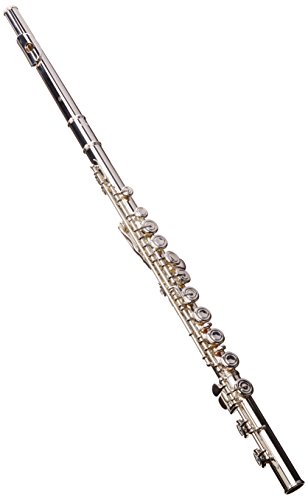 Yamaha YFL-222 Student Flute The student flute most band programs are built around. Pad seating and key alignment are the two things that decide whether a beginner flute plays, and this is where Yamaha earns the premium. | The flute a band director expects | 9.3/10 | $718.00View on Amazon #ad · price as of October 10, 2026 · how this is funded |
| 2 |  Gemeinhardt 2SP Student Flute The other name band rooms accept, and often cheaper than the Yamaha. A straight headjoint and silver-plated body: conventional, serviceable and easy to get repaired anywhere in the US. | A band-accepted flute at a lower price | 9.0/10 | $465.50View on Amazon #ad · price as of October 10, 2026 · how this is funded |
| 3 |  Jupiter 511S Plateau Offset-G Silver-Plated Flute The school-approved brand most parents have never heard of. Jupiter sits in the same price bracket as the Yamaha YFL-222 and is specified the same way — plateau keys, offset G, silver-plated — which makes it a real alternative when the Yamaha is back-ordered. | A school-list alternative to Yamaha | 9.0/10 | $715.00View on Amazon #ad · price as of October 10, 2026 · how this is funded |
| 4 | 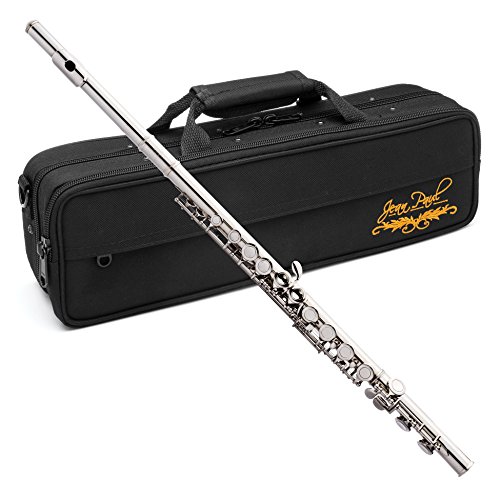 Jean Paul FL-220 Silver-Plated Flute The value pick with a US warranty behind it. Ask the band director first — some programs specify Yamaha or Gemeinhardt by name, and a rejected flute is an expensive lesson. | Value, with the director's approval first | 8.5/10 | $274.99View on Amazon #ad · price as of October 10, 2026 · how this is funded |
Scores are our own editorial fit rating from published specifications — the rubric is on our methodology page. They are not test results; we have not played these instruments.
Why the brand is the decision on a first flute
Every student flute on the market is specified almost identically: closed-hole (plateau) keys, an offset G, a straight headjoint and a C foot. Read five listings and you will read the same four lines. Our best beginner flutes page explains what each of those terms does for a player, and it is worth ten minutes before you spend anything.
What the spec lines do not tell you is the part that decides how the first two years go. A flute is a mechanism — dozens of pads, springs and pivot screws that have to seal and stay aligned. When one stops sealing, somebody has to open it up. Whether that is a twenty-dollar adjustment at the shop your school uses or an instrument nobody will touch is a function of the badge on the barrel, not of the specification sheet.
So the brand question is the real question, and it breaks down into four practical tests. None of them is about tone.
The four tests we judge a student flute brand on
We have not played these instruments and do not claim to have. Every specification below is read from the manufacturer’s or retailer’s published listing on a dated visit — see how we work for exactly what that means and what we will not do.
- Is it on the approval list? Most school programs hand out a sheet of acceptable brands, and some districts publish a list of brands they will not accept because their repair shop cannot get parts for them. A flute that fails this test is the worst purchase in this category: your child shows up with an instrument the program will not work with.
- Can a tech get parts? Brands sold through the band and orchestra trade have a parts channel — pads, springs, a replacement headjoint crown. Brands sold only as online bundles usually do not, which makes the whole instrument disposable the first time something bends.
- What happens at resale? Roughly half of beginners stop. A Yamaha or Gemeinhardt student flute has a deep used market; the import brands have almost none. That difference is real money and it is why the cheapest flute is not always the cheapest decision.
- Is the warranty answerable in the US? A warranty is only worth the address you send the instrument to. Two brands below publish US service, and we say so; for the rest, assume the listing is the whole of your recourse.
| Brand | Where it sits | Specified for a beginner? | The honest catch |
|---|---|---|---|
| Yamaha | The default on school approval lists | Yes — plateau keys, offset G | Costs the most of the five. You are paying for consistency and resale, not for features |
| Gemeinhardt | The other name every band room knows | Yes — plateau keys, straight headjoint | Long-running model, so used examples vary widely in condition |
| Jupiter | The band-trade brand parents have not heard of | Yes — plateau keys, offset G | Yamaha money without the Yamaha name, which costs you at resale |
| Jean Paul USA | The credible budget brand | Yes — silver-plated, closed hole | Not on every approval list. Ask before you buy |
| Eastar | Online import bundle | Closed hole, 16 keys per the listing | No repair or parts channel to speak of. Fine as a trial, not as a school instrument |
Read from each brand's published listing via the Amazon Creators API on 2026-10-09, with the live specification rows recorded against each product below. Where a listing does not publish a figure we write that rather than estimating it.
The two brands that are almost always accepted
Yamaha and Gemeinhardt are the student flutes school music programs are built around in the United States, and between them they account for most of the flutes in most band rooms. That matters for a reason that has nothing to do with snobbery: the technician your school uses has worked on hundreds of them, stocks the pads, and can turn a stuck key around in a day.
The Yamaha YFL-222 is the more expensive of the two and the one we would buy if the budget reaches it, for the single reason that pad seating out of the box is the most consistent in this group. A beginner who has to over-blow to make a note speak learns to over-blow, and that is a habit a teacher then spends a term removing. The Gemeinhardt 2SP is the alternative with the same acceptance and a lower price, and its listing publishes a straight headjoint — correct for a student, as our flute specification guide sets out.
Neither is exciting. That is the point. A first flute should be the boring, repairable, resalable choice, and the excitement should be budgeted for the step-up instrument three or four years later — which is a genuinely different decision, covered in our step-up flute guide.
Jupiter: the brand on the list that nobody has heard of
Jupiter is sold through the band and orchestra trade rather than through consumer electronics channels, which is why parents have usually never encountered the name and why band directors have. The 511S is specified the way a beginner flute should be — plateau keys and an offset G per the listing — and it sits in the same price bracket as the Yamaha.
We have it on this page because leaving it off would misrepresent the field: if the Yamaha you want is back-ordered in August, which happens every August, a Jupiter is a legitimate substitution rather than a compromise. The honest catch is resale. You pay Yamaha money and, four years later, you sell into a thinner used market because fewer buyers recognize the badge.
Before you buy any of them, ask one question
Ask the band director for the program’s approved-brand list, in writing, before you order anything. Programs differ, districts differ, and a brand that is fine at one school is refused at the next one over — usually because of the repair shop they contract with rather than because of the instrument. Our guide to asking the band director has the four questions worth asking in one email, and the list is the first of them.
Where the budget brands are honest, and where they are not
There is a real difference between the two cheap brands on this page, and collapsing them into “budget flutes” does a reader a disservice.
Jean Paul USA is a budget brand that behaves like a brand. The FL-220 is silver-plated and closed hole, it is sold with US-based service behind it, and enough school programs accept it that it is worth asking about. If the choice is between a Jean Paul now and renting for a year while you save, the Jean Paul is a defensible answer — see our rent-to-own explainer for how that math actually works out.
Eastar sits in a different category. The EFL-1 is an import bundle: a closed-hole flute with a case and cleaning kit at a price that is a fraction of the others. As a way to find out whether a ten-year-old likes making a sound on a flute, it is honest value, and we have said so on the roundup. As a school band instrument it is a problem, because the first time a key goes out of adjustment there is no parts channel and the repair cost approaches the price of the flute.
Below that tier is the part of the market we will not link to at all: the no-name flutes sold under a different brand name every six months. Some of them are unplayable new — pads that do not seal, keys that bind — and a beginner cannot tell the difference between an instrument that will not play and their own technique. That is the real cost, and it is not measured in dollars.
What about buying a used Yamaha instead?
For the price of a new Jean Paul you can often buy a used Yamaha or Gemeinhardt, and on paper that is the best value on this page. It is also the purchase with the most ways to go wrong: a flute that has been sat on has a bent body tube, and a flute stored for a decade needs a full repad that can cost more than the instrument.
The rule we would follow is simple. Buy used only if you can either play it first or have it checked by the shop your school uses, and budget a hundred dollars or so for an adjustment regardless. Our used instrument guide lists what to look at on a flute specifically, including the test that catches a leaking pad in ten seconds.
What we would do
Band program, budget reaches it: the Yamaha YFL-222. Most consistent pad seating in the group, accepted everywhere, and the resale market is deep enough that quitting is not a total loss.
Band program, tighter budget: the Gemeinhardt 2SP. Same acceptance, less money.
The Yamaha is out of stock: the Jupiter 511S, with the approval list checked first.
Not a school program, or a hedge: the Jean Paul FL-220 if it needs to be an instrument, the Eastar EFL-1 if it needs to be an experiment. Be clear with yourself which one you are buying.
What the price gap actually buys
Between the cheapest and the most expensive flute on this page there is a multiple, not a margin, and it is fair to ask where that money goes. It does not go into a better-sounding beginner: in the first year the limiting factor is the player’s air, not the instrument. Four things do change.
- Consistency between units. The established brands run tighter quality control, so the flute you receive plays like the flute the reviewer received. At the bottom of the market, two instruments of the same model can be noticeably different, and a beginner has no way to tell which one they got.
- Adjustment stability under school use. A band instrument lives in a locker and a car. The question is not whether it plays new, but whether it still seals in March.
- Serviceability. Whether the shop your program uses stocks the pads and springs, and whether they will take the job at all.
- Resale. The part nobody prices in at the start and everybody discovers at the end. A recognized student flute in reasonable condition sells; an unrecognized one is given away.
When the brand question can wait
If this is a first year and nobody in the household has played a wind instrument, renting is frequently the better answer than any purchase on this page — not because the instruments are bad, but because renting converts an unknown into a monthly cost and usually includes the maintenance that a beginner flute actually needs. Our rent-to-own explainer sets out the break-even arithmetic, and it is the one calculation on this site that tells readers not to buy.
The point at which buying wins is reasonably predictable: the student has finished a year, the band director expects them to continue, and the monthly rental has started to look like an instrument. At that point the brand question above becomes the right question, and the answer is usually the boring one.
Whichever brand you land on, the flute will play better and for longer if it is swabbed after every session, and that costs almost nothing — our flute cleaning kit page covers what belongs in the case. If your student is further along and their teacher has started talking about open holes, the open-hole versus closed-hole page is the one to read next, and it explains which of the usual sales claims about open holes are not true.
The picks, in full
Every card below is written from the published specification and the manufacturer’s own documentation. We have not played these instruments — see how we work for exactly what that means and what we do instead.
Our top pick · The flute a band director expects
Yamaha YFL-222 Student Flute
The student flute most band programs are built around. Pad seating and key alignment are the two things that decide whether a beginner flute plays, and this is where Yamaha earns the premium.
What works
- Consistent pad seating from new, so notes speak without over-blowing
- Offset G is standard, which suits smaller hands
- Every school repair tech knows the instrument
What to know
- Significantly more expensive than the import competition
- Closed-hole only — an advancing student will want open holes eventually
- Key
- C
- Holes
- Closed (plateau)
- G key
- Offset
- Foot
- C foot
#ad · price as of October 10, 2026 · how this is funded
Specs read from the manufacturer or retailer listing on 2026-09-07. Our fit score: 9.3/10.
Pick 2 · A band-accepted flute at a lower price
Gemeinhardt 2SP Student Flute
The other name band rooms accept, and often cheaper than the Yamaha. A straight headjoint and silver-plated body: conventional, serviceable and easy to get repaired anywhere in the US.
What works
- Long-established US brand with a wide service network
- Silver-plated head, body and foot
- Frequently the cheapest flute a school program will still accept
What to know
- Straight headjoint only — a young child may need a curved head to reach
- Case is basic
- Key
- C
- Headjoint
- Straight
- Plating
- Silver-plated
- Holes
- Closed (plateau)
#ad · price as of October 10, 2026 · how this is funded
Specs read from the manufacturer or retailer listing on 2026-09-07. Our fit score: 9.0/10.
Pick 3 · A school-list alternative to Yamaha
Jupiter 511S Plateau Offset-G Silver-Plated Flute
The school-approved brand most parents have never heard of. Jupiter sits in the same price bracket as the Yamaha YFL-222 and is specified the same way — plateau keys, offset G, silver-plated — which makes it a real alternative when the Yamaha is back-ordered.
What works
- Specified exactly as a beginner should be: plateau (closed-hole) keys and an offset G, per the listing
- Appears on school and district approval lists, so a band director is unlikely to object
- Sold through the band-and-orchestra trade, which means repair techs can get parts
What to know
- Costs the same as the Yamaha without the Yamaha name, which hurts resale
- Thinner used market than Yamaha or Gemeinhardt if you later want to sell it on
- Fewer listings than the big two, so stock and pricing move around
- Key
- C
- Holes
- Closed (plateau)
- G key
- Offset
- Body
- Silver-plated
#ad · price as of October 10, 2026 · how this is funded
Specs read from the manufacturer or retailer listing on 2026-10-09. Our fit score: 9.0/10.
Pick 4 · Value, with the director's approval first
Jean Paul FL-220 Silver-Plated Flute
The value pick with a US warranty behind it. Ask the band director first — some programs specify Yamaha or Gemeinhardt by name, and a rejected flute is an expensive lesson.
What works
- Silver-plated body at well below the established brands
- US-based warranty and service, unusual at this price
- Offset G and closed holes, the standard student layout
What to know
- Some directors specify Yamaha or Gemeinhardt only
- Pad life is shorter than the premium student flutes
- Key
- C
- Plating
- Silver-plated
- Holes
- Closed (plateau)
- G key
- Offset
#ad · price as of October 10, 2026 · how this is funded
Specs read from the manufacturer or retailer listing on 2026-09-07. Our fit score: 8.5/10.
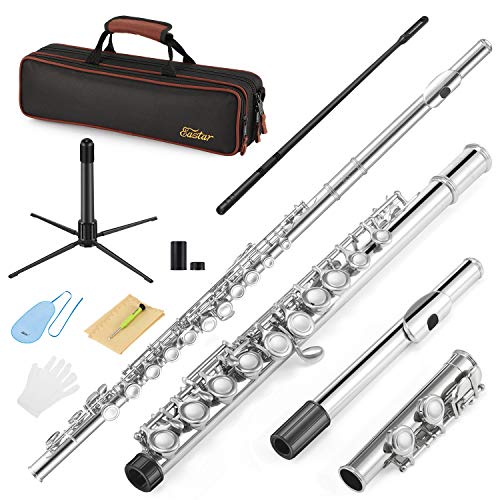
We would skip this one
Eastar EFL-1 16-Key Closed Hole Flute
A complete kit at the bottom of the market. If band participation is the goal, check with the director before buying — many programs will not service or accept an unbranded import.
What works
- Full kit with case, cleaning rod, gloves and stand
- Low enough cost to test interest without commitment
What to know
- Pad seating is inconsistent from new, which makes a beginner sound worse than they are
- Frequently not accepted or serviced by school band programs
- Key
- C
- Keys
- 16, closed hole
- Kit
- Case, rod, gloves, stand (per listing)
#ad · price as of October 10, 2026 · how this is funded
Specs read from the manufacturer or retailer listing on 2026-09-07. Our fit score: 6.8/10.
Questions people actually ask
What is the best brand of flute for a beginner?
Yamaha, with Gemeinhardt as the close alternative. Both are accepted by essentially every school program in the United States, both are specified correctly for a beginner with closed-hole keys, and both have the parts and repair network that decides what happens when a pad stops sealing in year two.
Is Jean Paul a good flute brand for a student?
It is the most credible of the budget brands: the FL-220 is silver-plated and closed hole, and the company has US service behind it. The catch is that not every school program lists it as approved, so ask the band director for the approved-brand list before ordering.
Are cheap flutes from unknown brands worth buying?
Only as an experiment, never as a school instrument. The problem is not the sound, it is that there is no parts or repair channel, so the first key adjustment can cost a meaningful fraction of the flute's price. A beginner also cannot tell a flute that will not play from their own technique.
Which flute brands do school bands accept?
Most programs publish their own list, and Yamaha, Gemeinhardt and Jupiter appear on nearly all of them. Some districts explicitly exclude import brands because their contracted repair shop cannot source parts. Always ask for the list in writing before you buy, because the lists genuinely differ school to school.
Should I buy a used Yamaha instead of a new budget flute?
Often yes, with one condition: have it checked by the shop your school uses, or buy it from that shop, and budget for an adjustment on top of the purchase. A bent body tube or a full repad can cost more than the flute, and neither is visible in a listing photograph.
Sources
We have not played these instruments, so citation is our evidence. Everything above traces back to one of these, on the date shown.