How to tune a guitar
A guitar that is out of tune teaches a beginner the wrong pitches and sounds bad no matter how well it is played, and tuning it is a two-minute skill nobody is taught properly.
By Stephen V. · Writes Reed & Rosin · last verified
The short answer
Standard tuning, from the thickest string to the thinnest, is E A D G B E. Clip a tuner to the headstock, play one string at a time, and turn the machine head until the tuner reads the right letter with the needle centred. Always tune up to the note, not down to it.
Some links on this page earn us a commission at no extra cost to you. It does not change which instrument we recommend, and it does not change the order. We also earn nothing when the honest answer is “rent it” — and we still say so. Full disclosure.
Quick picks
| # | Product | Best for | Score | Price |
|---|---|---|---|---|
| 1 |  Snark SN5X Clip-On Chromatic Tuner A vibration-sensing clip-on works in a noisy band room where a microphone tuner cannot. The SN5X covers guitar, bass and violin, which means one tuner for a household with two players. | Tuning in a noisy room | 8.9/10 | $22.24View on Amazon #ad · price as of September 17, 2026 · how this is funded |
| 2 | 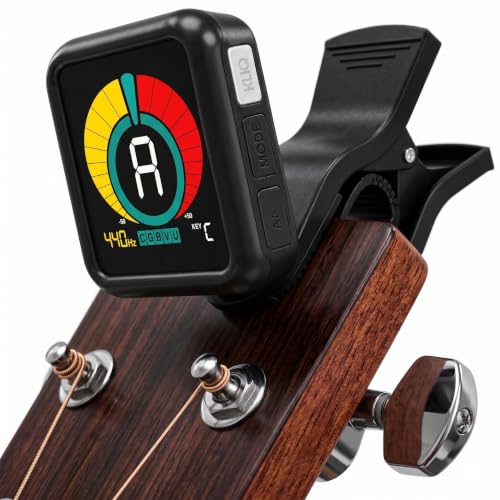 KLIQ UberTuner Clip-On A sturdier clip and a faster processor than the budget clip-ons, which matters mostly because the clip is what fails. Worth the small premium for an instrument handled by a child. | A clip-on that survives a school bag | 8.8/10 | $26.99View on Amazon #ad · price as of September 17, 2026 · how this is funded |
| 3 |  D'Addario EJ16 Phosphor Bronze Light The default acoustic string for a reason: 12-53 light gauge is the balance point between tone and finger comfort, and phosphor bronze is the standard warm acoustic voice. | The standard acoustic restring | 9.0/10 | $9.99View on Amazon #ad · price as of September 17, 2026 · how this is funded |
Scores are our own editorial fit rating from published specifications — the rubric is on our methodology page. They are not test results; we have not played these instruments.
Standard tuning, lowest string to highest
Hold the guitar in playing position. The thickest string, nearest your face, is string six and it is the lowest note. The thinnest, nearest the floor, is string one.
| String | Thickness | Note | Frequency | What a tuner shows |
|---|---|---|---|---|
| 6th (nearest your face) | Thickest | E | 82.41 Hz | E2, or just E |
| 5th | A | 110.00 Hz | A2, or just A | |
| 4th | D | 146.83 Hz | D3, or just D | |
| 3rd | G | 196.00 Hz | G3, or just G | |
| 2nd | B | 246.94 Hz | B3, or just B | |
| 1st (nearest the floor) | Thinnest | E | 329.63 Hz | E4, or just E |
Frequencies are the standard equal-temperament values with A above middle C set to 440 Hz, which is what every tuner, app and piano in a school assumes unless told otherwise. Most clip-on tuners display the letter and an octave number; the number confirms you are on the right string rather than an octave out.
Two E strings, two octaves apart, at either end. That symmetry is worth noticing because it is the first sanity check: if your first and sixth strings are not both reading E, something is on the wrong peg.
Tuning with a clip-on tuner
- 1
Clip the tuner to the headstock and switch it on
The headstock is the flat piece at the end of the neck where the tuning pegs are. A clip-on reads vibration through the wood rather than sound through the air, which is why it works in a noisy room where a phone app does not.
- 2
Set it to chromatic mode if it has one
Chromatic means it tells you the nearest note to whatever you played, rather than assuming you are already close. That is what a beginner needs, because a badly out-of-tune string may be nowhere near the note it should be.
- 3
Play the sixth string on its own and let it ring
One string at a time, fretting nothing. Pluck it with a normal amount of force - very hard plucking pushes the pitch up briefly and makes the reading jump around.
- 4
Read the letter first, then the needle
If the tuner shows a different letter entirely, you are far off and turning the peg a long way is correct. Once it reads E, the needle or colour tells you whether you are sharp (too high) or flat (too low).
- 5
Turn the machine head slowly and watch the display
Small movements. A quarter turn moves the pitch a surprising amount on the thin strings. Keep plucking as you turn so the tuner is reading a live note.
- 6
Finish by coming up to the note, not down to it
If you overshoot, drop the string clearly below pitch and bring it back up. Arriving from below seats the string in the nut and around the post, and it is the single reason one person's tuning holds and another's slips within a minute.
- 7
Repeat on strings five to one, then check the sixth again
Bringing five strings up to tension bends the neck very slightly, which pulls the first one you tuned out again. One full pass, then a second check, and it is done.
Which way do I turn it?
There is no universal answer, because it depends on which side of the headstock the peg is and how the string is wound on. So do not memorise a direction — learn the two-second test instead.
Turn the peg a small amount and watch the tuner. If the pitch went the wrong way, turn the other way. That is the whole technique, and it works on every guitar including the ones where three pegs turn one way and three the other.
The one thing to avoid is turning a peg a long way while watching your hand rather than the tuner. That is how a thin string gets snapped, and how a beginner concludes that tuning is dangerous.
Why it goes out of tune again ten minutes later
On a new guitar or a new set of strings, this is normal and it is not a fault. A fresh string stretches for the first few hours of playing, and every stretch drops the pitch. Tune it, play for five minutes, tune it again, and repeat a few times. After the first day or two it settles.
You can speed it up: after tuning, take hold of each string over the soundhole or pickups and pull it gently away from the fretboard an inch or so, then retune. Two or three cycles of that does most of the stretching in a few minutes.
If a guitar drifts out of tune within a song and the strings are not new, something else is going on. The most common causes are cheap tuning machines that slip, a string wound badly around its post, or strings that are simply finished. Old strings will not hold pitch reliably and they sound dull — when to change guitar strings covers the signs, and the standard light-gauge acoustic set above is cheap enough to change on schedule rather than when they die.
Tuning by ear, and the fifth-fret method
Worth learning eventually, not first. The classic method is relative tuning: get the sixth string right with a tuner, then fret it at the fifth fret and match the open fifth string to it. Repeat from the fifth string to the fourth, and the fourth to the third. The one exception is the second string, which is matched from the fourth fret of the third string rather than the fifth.
The advantage is that the guitar will sound in tune with itself even if it is slightly off concert pitch. The disadvantage is that small errors compound along the way, and it does not help a beginner who cannot yet hear a small difference in pitch. Learn it as a backup for when the tuner battery dies.
Tunings other than standard
Two come up early, usually because a song asks for them, and both are simple once standard tuning is second nature.
Half a step down lowers every string by one fret, giving Eb Ab Db Gb Bb Eb. A chromatic tuner shows the flat names directly, so the method is unchanged: tune each string until the display reads the new letter. It is common in rock recordings, and it makes the strings slightly slacker and easier to bend, which is a small bonus for a beginner.
Drop D changes only the sixth string, from E down to D, and leaves the other five alone. It is the easiest alternate tuning to learn and the easiest to undo. Because only one string moves, bring it back up to E from below when you are finished rather than easing it down, for exactly the reason above.
Whatever the tuning, the guitar has to be capable of holding it. Strings past their life will not hold any tuning reliably, and neither will a badly wound string.
The three mistakes beginners make
- Tuning to the wrong octave. Turning a string up a long way can land it an octave high, at which point the tuner reads the correct letter and the string is dangerously tight. Check the octave number on the display, and be suspicious if a string suddenly feels very stiff.
- Fretting a note while tuning. Every string is tuned open, with nothing held down. A beginner pressing the string anywhere on the neck tunes it to the wrong pitch.
- Tuning once and then playing for a week. A guitar drifts with temperature and humidity even when nothing is wrong with it. Tuning before every session takes thirty seconds and it is the difference between practising the right pitches and practising the wrong ones.
Tuner, phone app, or by ear
A clip-on tuner is the right first purchase. It reads vibration through the instrument, so it works in a noisy band room or a house with a television on, and it costs very little. A phone app is fine in a quiet room and useless in a loud one, because it listens through the microphone.
One clip-on that covers guitar, bass and violin also handles a household with more than one player. The alternatives are compared on the tuner page.
If it still sounds wrong in tune
A guitar can be perfectly tuned open and still sound out of tune when you play a chord up the neck. That is intonation rather than tuning, and it is set at the bridge by a shop during a setup. It is one of the several things a setup fixes, and on a cheap new guitar it is usually worth the money — the reasoning is on the main guitar roundup, and the starter kit page covers the tuner, strings and stand a first guitar needs alongside it.
The picks, in full
Every card below is written from the published specification and the manufacturer’s own documentation. We have not played these instruments — see how we work for exactly what that means and what we do instead.
Our top pick · Tuning in a noisy room
Snark SN5X Clip-On Chromatic Tuner
A vibration-sensing clip-on works in a noisy band room where a microphone tuner cannot. The SN5X covers guitar, bass and violin, which means one tuner for a household with two players.
What works
- Reads vibration through the instrument, so ambient noise does not confuse it
- Covers guitar, bass and violin in one unit
- Full-color display a child can read across a room
What to know
- The clip hinge is the failure point — it is the part that breaks first
- Battery drains if the tuner is left clipped on and switched on
- Type
- Clip-on, vibration sensing
- Instruments
- Guitar, bass, violin
- Chromatic
- Yes
#ad · price as of September 17, 2026 · how this is funded
Specs read from the manufacturer or retailer listing on 2026-09-07. Our fit score: 8.9/10.
Pick 2 · A clip-on that survives a school bag
KLIQ UberTuner Clip-On
A sturdier clip and a faster processor than the budget clip-ons, which matters mostly because the clip is what fails. Worth the small premium for an instrument handled by a child.
What works
- Noticeably stronger clip and hinge than the cheapest units
- Fast, stable readout that does not hunt around the note
- Wide instrument coverage including chromatic mode
What to know
- Costs slightly more than a Snark
- Display is smaller than the Snark's
- Type
- Clip-on, vibration sensing
- Chromatic
- Yes
#ad · price as of September 17, 2026 · how this is funded
Specs read from the manufacturer or retailer listing on 2026-09-07. Our fit score: 8.8/10.
Pick 3 · The standard acoustic restring
D'Addario EJ16 Phosphor Bronze Light
The default acoustic string for a reason: 12-53 light gauge is the balance point between tone and finger comfort, and phosphor bronze is the standard warm acoustic voice.
What works
- Light 12-53 gauge is easier on new fingertips than mediums
- Phosphor bronze holds its brightness longer than 80/20 bronze
- Cheap enough to change on schedule rather than when they sound dead
What to know
- Uncoated, so they dull faster than a treated string in humid hands
- Gauge
- 12-53 (light)
- Material
- Phosphor bronze
- Coating
- None
#ad · price as of September 17, 2026 · how this is funded
Specs read from the manufacturer or retailer listing on 2026-09-07. Our fit score: 9.0/10.
Questions people actually ask
What are the six guitar strings tuned to?
From the thickest string to the thinnest: E, A, D, G, B, E. That is standard tuning, and it is what every method book, chord chart and app assumes unless it says otherwise.
How do I tune a guitar without a tuner?
Use relative tuning. Get the sixth string right against any reliable reference, then fret it at the fifth fret and match the open fifth string to it, and so on up the guitar. The second string is the exception, matched from the fourth fret of the third string.
Why does my new guitar keep going out of tune?
New strings stretch for the first few hours of playing, and every stretch drops the pitch. Tune, play, and retune several times over the first day or two. Gently pulling each string away from the fretboard and retuning speeds it up.
Should I tune up to the note or down to it?
Up. Arriving at the pitch from below seats the string in the nut and around the tuning post, so it holds. If you overshoot, drop the string clearly below pitch and bring it back up rather than easing it down.
Sources
We have not played these instruments, so citation is our evidence. Everything above traces back to one of these, on the date shown.