The best beginner trombones, and when to rent instead
Trombone is the band instrument where the cheap option fails in a specific, predictable way — and the specification that would warn you is usually missing from the listing.
By Stephen V. · Writes Reed & Rosin · last verified
The short answer
For a school band student, rent first: slide action decides how a trombone plays, and it is the first thing a low-cost horn compromises. If you are buying outright, the Yamaha YSL-354 is the student horn directors approve, and a pBone is the honest answer for a player too small for brass.
Some links on this page earn us a commission at no extra cost to you. It does not change which instrument we recommend, and it does not change the order. We also earn nothing when the honest answer is “rent it” — and we still say so. Full disclosure.
Quick picks
| # | Product | Best for | Score | Price |
|---|---|---|---|---|
| 1 |  Yamaha YSL-354C Student Trombone The student trombone a director will recognize by name, and the only horn on this page that publishes what its inner slide is made of. On a trombone that is not a detail — the inner slide is the part that decides whether the instrument still moves cleanly in year three. | The trombone a program will approve | 9.4/10 | $1,921.00View on Amazon #ad · price as of October 2, 2026 · how this is funded |
| 2 |  Jean Paul TB-400 Tenor Trombone Jean Paul's trombone occupies the gap this instrument otherwise does not have: a step above the imports, well below the name-brand student horns, from a seller with a service path. It is also the least documented thing on this page. | A mid-price buy with no brand list to satisfy | 8.3/10 | $499.99View on Amazon #ad · price as of October 2, 2026 · how this is funded |
| 3 |  Eastar ETB-330 Bb Tenor Trombone The most completely specified instrument in the budget bracket, which is the reason it is here rather than one of its neighbors. Read the bore figure before you buy it: the number Eastar publishes is wider than the student standard, not narrower. | The cheapest full-size brass we would consider | 7.4/10 | $209.99View on Amazon #ad · price as of October 2, 2026 · how this is funded |
| 4 |  pBone Bb Plastic Trombone A plastic trombone that is a real instrument rather than a toy: the published bore is the same 0.500 in as a brass student horn and it is pitched in Bb, so it plays the same part. What you trade is slide feel, repairability and, in some programs, acceptance. | A small player, and houses that cannot take the weight question | 8.2/10 | $199.00View on Amazon #ad · price as of October 2, 2026 · how this is funded |
| 5 |  pBone Mini Eb Plastic Trombone The honest answer to the arm-length problem, with one condition that decides everything: it is pitched in Eb, not Bb. For a child who physically cannot reach the lower positions it works beautifully. For a school band part written for a Bb tenor, it does not. | A child too small for a full-size trombone | 7.6/10 | |
| 6 |  Essential Elements for Band Book 1 - Trombone The trombone part of the method most American school bands use. Ask which book the program has adopted before buying anything at all — the right book for the wrong program is still the wrong book. | First-year band trombone | 9.3/10 | |
| 7 |  MusicNomad Premium Trombone T-Slide Lubricant, 2 oz (MN704) A trombone slide wants a lubricant and then water, in that order, and this is the bottle to own. Slide-specific rather than a general valve oil, and odorless, which matters when the practice happens in a bedroom. | Keeping a student slide moving | 8.9/10 | $8.49View on Amazon #ad · price as of October 2, 2026 · how this is funded |
Scores are our own editorial fit rating from published specifications — the rubric is on our methodology page. They are not test results; we have not played these instruments.
Buying this as a gift? Our gift guides re-explain these picks for the gifter. Wondering whether to wait for November? The Black Friday hub has the sourced record of what discounted last year and what did not.
Start with the sentence nobody selling trombones will write
A trombone has no valves, no keys, no pads and no corks. Almost everything that goes wrong with a beginner clarinet or a beginner trumpet simply cannot happen here. What a trombone has instead is a hand slide: two thin tubes, machined to fit inside two other thin tubes, that have to glide the length of an arm without catching. That slide is the instrument. It is also the one part of a trombone that cannot be made cheaply, which is why the failure mode in this market is so predictable — a horn that looks identical to a good one in a photograph and sticks in third position by November.
That is why our trumpet versus trombone page says we would rent a first trombone, and why this page does not reverse that. A school rental puts a serviced slide in a student’s hands and covers the repair when they drop the thing, which beginners do. We earn nothing when you rent and we still say rent first. The rent-versus-buy tables have the actual arithmetic, including the month at which buying starts to win.
But plenty of families buy anyway, for reasons that are perfectly sound: the program has no rental partner, the rental stock is gone by the second week of school, an adult beginner is not in a program at all, or a younger sibling is going to inherit the thing. If you are buying, the rest of this page is the honest version of how to do it.
Four minutes with the band director saves every mistake below
Programs publish approved-brand lists, some own instruments and loan them out, and a few will refuse a plastic horn in concert band. Our questions to ask the band director is a short list that settles brand, rental, book and mouthpiece in one conversation. Ask first. Nothing on this page outranks the person who has to teach the child.
The arm-reach check, before you spend anything
A Bb tenor trombone has seven slide positions, and the sixth and seventh are a long way out. A student who cannot reach them cannot play the lowest notes in their part, and no amount of practice changes a limb length. The check takes a minute in a band room: the student holds the instrument in playing position and extends the slide. If the arm runs out before the slide does, trombone is not a “no” — but it is a question for the director rather than for a checkout page.
There are four honest ways forward when the answer is no, and the first one belongs to the director rather than to you: many programs fit a slide extension handle, which brings the lower positions back within reach of a shorter arm, and a program that teaches trombone to sixth-graders will usually own one. Beyond that, the program may move the student to another brass instrument for a year and bring them across later, which is the route our school band guide describes and the route most directors prefer. The student can wait a year. Or, for a child well below band age who is desperate to play a trombone now, there is a short Eb instrument built exactly for this situation — with one condition attached that decides everything, and that we have put first on its card rather than last: an Eb alto trombone does not play a Bb tenor part at concert pitch. It is a pre-band instrument, not a band instrument.
What we judged these on
We have not played these instruments and do not claim to have. Every figure below comes from the manufacturer’s or the retailer’s own published specification, read on a dated visit — see how we work. Six things separate a trombone a student keeps for four years from one that quietly ends up under a bed.
- What the inner slide is made of. The single most useful line on a trombone listing, and the one most often absent. Nickel silver inner tubes stay smooth as the instrument wears; softer plated brass does not. Exactly one horn on this page publishes this figure, and that is most of the reason it is ranked first.
- Bore size. The diameter of the tubing, and the number that decides how much air a beginner has to move. More on this below, because it is the spec most likely to be quietly wrong for a student.
- Weight, and whether there is a counterweight. A trombone is held out in front of a player by one hand for the whole rehearsal. A counterweight shifts the balance back toward the body, and its absence is felt by a small player in week one, not year three.
- What is actually in the case. A mouthpiece the student can use, a case that will survive a bus, and a cleaning rod. Every instrument here includes a mouthpiece; they are not the same mouthpiece, and if the director has specified one, that specification wins.
- Whether a repair shop can identify it. This sounds like snobbery and is not. A technician orders parts against a model number. A listing whose model number is a warehouse SKU gives them nothing to order, and the instrument becomes disposable the first time something bends.
- Whether the program will accept it. Relevant for exactly one category — plastic — and genuinely worth a question before you buy.
Bore size: the one number worth reading on the listing
Trombone tubing comes in diameters, and the figure matters more for a beginner than almost anything else on a spec sheet. A narrower bore takes less air to fill, so a note arrives sooner and a twelve-year-old with twelve-year-old lungs is not fighting the instrument. A wider bore moves more air and is what an advanced player wants for volume and tone, and is exactly the wrong gift to give someone in their first term.
The student-bracket figure is 0.500 inches. Yamaha publishes that number for the YSL-354 and labels it medium; pBone publishes the same 0.500 inches and calls it standard. Here is where this gets useful: two of the cheapest full-size brass trombones we could verify as available publish wider figures than that — Eastar states a 13.4 mm bore, which is about 0.528 inches, and the unbranded listing we have flagged as a skip states 0.53 inches. Neither is lying. Both are selling a large-bore horn to beginners, and a beginner will notice.
| Instrument | Bore | Bell | Inner slide | Mouthpiece in the box |
|---|---|---|---|---|
| Yamaha YSL-354C | 0.500 in (medium) | 8 in yellow brass | Nickel silver | SL-48S |
| Jean Paul TB-400 | Not published | Not published | Not published | 12C |
| Eastar ETB-330 | 13.4 mm (about 0.528 in) | 206 mm (about 8.1 in) | Not published | 7C |
| pBone (Bb) | 0.500 in (standard) | Not published | ABS plastic | 6.5AL and 11C |
| pBone Mini (Eb) | Not published | Not published | ABS plastic | One included, size not published |
Read from each manufacturer's or retailer's published specification on 2026-10-02 and listed in the Sources block below. Where a figure is not published we write that rather than estimating it — a bore size guessed from a photograph would be worth less than an empty cell.
The honest reading of that table is uncomfortable for the middle of the market. The expensive horn publishes everything. The cheapest brass horn publishes a bore and a bell, and the bore is wider than a student wants. And the mid-price option, which is otherwise a sensible instrument from a brand with a service path, publishes neither a bore nor a bell — not on the listing and not on its own website, which we checked. If you want to see what the same brand difference looks like across the other band instruments, Jean Paul versus Yamaha sets it out instrument by instrument.
Plastic trombones: a real instrument, with real conditions
A plastic trombone invites an obvious assumption, and in this one case the assumption is wrong. The pBone publishes a 0.500-inch bore and is pitched in Bb — the same bore and the same key as a brass student horn — which means it plays the part the student is handed, in the position the part expects. Its manufacturer states it weighs half what a brass trombone does, and weight is the barrier that actually stops small beginners from holding an instrument in correct form. There is nothing to lacquer, nothing to dent and nothing to corrode.
The trade is real and we are not going to talk around it. A plastic slide does not feel like a nickel-silver one, so a student who moves to brass later has some adjusting to do. It is not repairable the way brass is: a damaged slide is a replacement rather than a trip to the shop. And some programs will not accept a plastic instrument in concert band, which is a question to ask before the parcel arrives rather than after. Where it is clearly the right answer: a player who is small for their age, a family that wants a second instrument to leave at a grandparent’s house, and the child who would otherwise not be able to hold a trombone up for a whole rehearsal.
The brass budget bracket, and what you are actually buying
Below the name brands, the full-size brass trombones all look alike in a photograph, and the difference between them is how much they are willing to tell you. Eastar publishes a model number that belongs to a supported line, a bore, a bell, a mouthpiece size, a warranty term and a list of what is in the case. That is why it is the cheapest brass horn we would consider, with its bore figure stated plainly as the reservation it is.
The listing we have flagged as a skip is the other end of that spectrum, and it is on this page precisely because it is what a search for a cheap trombone returns first. Its own model number is “trombone-0732” — a warehouse SKU, not a model line. Its specification sentence runs a 0.53-inch figure and a 9.4-inch figure together with the word mouthpiece in a way that leaves it genuinely unclear what was measured. And it publishes nothing whatsoever about the hand slide. On a trombone, that is like selling a bicycle without mentioning the wheels.
One more route is worth knowing about, because it is frequently the best one and we earn nothing from it: programs and school-music dealers sell off their own ex-rental horns, serviced, at prices that no import can match for the build quality. Our guide to buying a used instrument has the checks to run, and the trombone-specific one is simple — the slide should travel its full length under one finger, smoothly, with no catch anywhere in the throw.
What the first month actually needs
The instrument is not the whole purchase, and the rest of it is cheap. A trombone slide wants a lubricant and a spray bottle of water, used together: the lubricant goes on, the water keeps it moving, and a slide treated this way stays quiet for weeks. A slide-specific lubricant is the right product here rather than the valve oil that lives on our valve oil page — that page covers brass lubrication generally and is worth ten minutes, but valve oil is not what a hand slide wants.
Then the book, which is the part most often forgotten at the till and the only thing on this page that is genuinely not optional. Trombone reads bass clef at concert pitch, so the trombone edition of a band method is written for the instrument rather than transposed into it, and buying the wrong instrument’s book is a mistake that takes three weeks to notice. Ask which method the program has adopted before ordering — the most widely used one in American schools is the pick below, and it is still the wrong book if the program uses a different series. Our trumpet method books page explains how the same series works across a band, if you have more than one player in the house.
Everything else can wait. A music stand and a cleaning snake are worth having by the end of the first term, and both are covered on the music stands page and in the first-year checklist.
What we would do
Child starting in a school program: rent, for the first year, from whoever the program uses. Then read the rent-versus-buy table in month nine rather than month one, when you know whether the student is still playing.
Buying outright, with the budget for it: the Yamaha. It is the only horn here that publishes its inner-slide material, and it is a name every band room and every repair shop already knows.
Buying outright on a real budget: the Eastar if the student is physically big enough to fill a wider bore, and the pBone if they are not — having asked the director about plastic first.
A child under band age: the pBone Mini, understanding that it is pitched in Eb and is a way to start, not a way to join the band.
If trombone has not actually been settled yet, the school band instrument guide runs through what each section asks of a student, and what instruments cost compares the running costs — which is where trombone quietly wins, because a slide lubricant once a term is the whole consumable bill. The band instruments hub collects the care, consumable and method-book pages for every instrument a program is likely to offer.
The picks, in full
Every card below is written from the published specification and the manufacturer’s own documentation. We have not played these instruments — see how we work for exactly what that means and what we do instead.
Our top pick · The trombone a program will approve
Yamaha YSL-354C Student Trombone
The student trombone a director will recognize by name, and the only horn on this page that publishes what its inner slide is made of. On a trombone that is not a detail — the inner slide is the part that decides whether the instrument still moves cleanly in year three.
What works
- Nickel silver inner slide, the material that keeps slide action smooth as an instrument wears
- Published 0.500 in bore — the student standard, so a beginner is not asked to fill a large-bore horn
- Case, SL-48S mouthpiece and a detachable counterweight included
- Stocked in school programs everywhere, so parts, repair and resale are all straightforward
What to know
- Costs several times what the imports below cost, which is exactly why the rent-versus-buy arithmetic comes first
- No F attachment, so a student who stays with the instrument will want a larger horn eventually
- Amazon stock on this model runs thin, and a school-music dealer is often the steadier source
- Key
- Bb tenor
- Bore
- 0.500 in (medium)
- Bell
- 8 in yellow brass
- Inner slide
- Nickel silver
- Outer slide
- Yellow brass
- Finish
- Gold lacquer
- Included
- Case, SL-48S mouthpiece, detachable counterweight
- Warranty
- 2 years
#ad · price as of October 2, 2026 · how this is funded
Specs read from the manufacturer or retailer listing on 2026-10-02. Our fit score: 9.4/10.
Pick 2 · A mid-price buy with no brand list to satisfy
Jean Paul TB-400 Tenor Trombone
Jean Paul's trombone occupies the gap this instrument otherwise does not have: a step above the imports, well below the name-brand student horns, from a seller with a service path. It is also the least documented thing on this page.
What works
- Yellow brass body with a solid counterweight for balance
- Hard case, 12C mouthpiece, cleaning rod and cloth in the box
- A US brand with a stated warranty and somewhere to call, unlike the no-name listings
What to know
- No bore size or bell diameter is published for this model — not on the listing and not on Jean Paul's own site
- The listing contradicts itself, describing an alto trombone in a bullet while the title says tenor
- One-year warranty against Yamaha's two
- Key
- Bb tenor
- Bore
- Not published
- Bell
- Not published
- Body
- Yellow brass
- Included
- Hard case, 12C mouthpiece, cleaning rod, cloth
- Warranty
- 1 year
#ad · price as of October 2, 2026 · how this is funded
Specs read from the manufacturer or retailer listing on 2026-10-02. Our fit score: 8.3/10.
Pick 3 · The cheapest full-size brass we would consider
Eastar ETB-330 Bb Tenor Trombone
The most completely specified instrument in the budget bracket, which is the reason it is here rather than one of its neighbors. Read the bore figure before you buy it: the number Eastar publishes is wider than the student standard, not narrower.
What works
- Actually publishes its specifications — a 13.4 mm bore and a 206 mm bell
- Hard case, 7C mouthpiece, cleaning kit and gloves included
- A named model in a supported line, with a stated 12-month warranty
What to know
- 13.4 mm is about 0.528 in, wider than the 0.500 in student standard, so a beginner has more air to move
- Nothing is published about the inner slide material, which is the part that decides how a slide ages
- A budget slide is the first thing to go sticky, and not every band shop will work on one
- Key
- Bb tenor
- Bore
- 13.4 mm (about 0.528 in)
- Bell
- 206 mm (about 8.1 in)
- Body
- Brass with dual-layer lacquer
- Inner slide
- Not published
- Included
- Hard case, 7C mouthpiece, cleaning kit, gloves
- Warranty
- 12 months
#ad · price as of October 2, 2026 · how this is funded
Specs read from the manufacturer or retailer listing on 2026-10-02. Our fit score: 7.4/10.
Pick 4 · A small player, and houses that cannot take the weight question
pBone Bb Plastic Trombone
A plastic trombone that is a real instrument rather than a toy: the published bore is the same 0.500 in as a brass student horn and it is pitched in Bb, so it plays the same part. What you trade is slide feel, repairability and, in some programs, acceptance.
What works
- Standard 0.500 in bore pitched in Bb, so the part a student is handed is playable on it
- pBone states it weighs half what a brass trombone does, which is the single biggest barrier for a small beginner
- Two mouthpieces (6.5AL and 11C) and a fabric case included, with nothing to lacquer, dent or corrode
What to know
- A plastic slide does not feel like a brass one, and there is some adjusting to do when a student moves across
- Some programs will not accept a plastic instrument in concert band — ask before you buy
- Not repairable the way brass is: a damaged slide is a replacement rather than a repair
- Key
- Bb tenor
- Bore
- 0.500 in (standard)
- Body
- ABS plastic
- Bell
- Not published
- Included
- 6.5AL and 11C mouthpieces, fabric case
#ad · price as of October 2, 2026 · how this is funded
Specs read from the manufacturer or retailer listing on 2026-10-02. Our fit score: 8.2/10.
Pick 5 · A child too small for a full-size trombone
pBone Mini Eb Plastic Trombone
The honest answer to the arm-length problem, with one condition that decides everything: it is pitched in Eb, not Bb. For a child who physically cannot reach the lower positions it works beautifully. For a school band part written for a Bb tenor, it does not.
What works
- Short enough that a six- or seven-year-old can reach every slide position
- Published weight of about 1.3 lb, so holding it in correct form is actually possible
- Mouthpiece, lockable slide and fabric case included, and nothing to maintain
What to know
- Pitched in Eb, so it will not play a standard Bb tenor part at concert pitch — this is a pre-band instrument, not a band instrument
- Slide positions are not the Bb tenor positions, so a child who starts here relearns them later
- The listing says dual bore but publishes no bore measurement
- Key
- Eb alto
- Bore
- Not published
- Body
- ABS plastic
- Weight
- About 1.3 lb (published)
- Included
- Mouthpiece, lockable slide, fabric case
Specs read from the manufacturer or retailer listing on 2026-10-02. Our fit score: 7.6/10.
Pick 6 · First-year band trombone
Essential Elements for Band Book 1 - Trombone
The trombone part of the method most American school bands use. Ask which book the program has adopted before buying anything at all — the right book for the wrong program is still the wrong book.
What works
- Bass clef at concert pitch from the first page, written for the trombone rather than transposed into it
- Parts align across the whole band, so the class works through the same page together
- EEi online resources, play-along audio and a start-up video come with the book
What to know
- Paced for a class of thirty rather than a fast individual learner
- Some programs use Standard of Excellence or Tradition of Excellence instead
- Level
- Book 1
- Instrument
- Trombone (bass clef)
- Online resources
- EEi access included
Specs read from the manufacturer or retailer listing on 2026-10-02. Our fit score: 9.3/10.
Pick 7 · Keeping a student slide moving
MusicNomad Premium Trombone T-Slide Lubricant, 2 oz (MN704)
A trombone slide wants a lubricant and then water, in that order, and this is the bottle to own. Slide-specific rather than a general valve oil, and odorless, which matters when the practice happens in a bedroom.
What works
- A water and synthetic oil emulsion formulated for hand slides, not a repurposed valve oil
- Petroleum-free and odorless, with anti-corrosion additives
- 2 oz lasts a student a very long time
What to know
- The lubricant alone is not the routine — a slide still needs a water spray bottle alongside it
- An awkward thing to buy by itself, so add it to an order rather than ordering it alone
- For
- Trombone hand slide
- Size
- 2 oz
- Base
- Water and synthetic oil emulsion
- Petroleum
- Petroleum-free
#ad · price as of October 2, 2026 · how this is funded
Specs read from the manufacturer or retailer listing on 2026-10-02. Our fit score: 8.9/10.
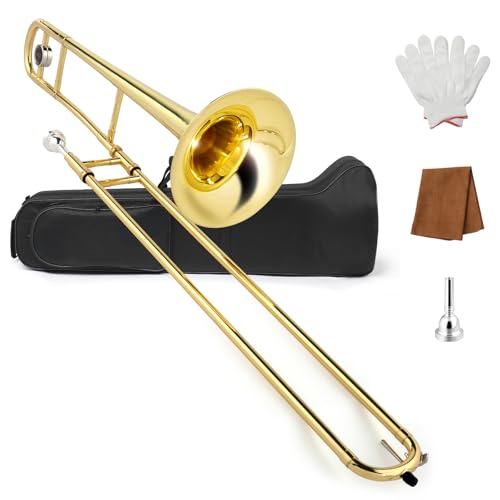
We would skip this one
Ktaxon Bb Tenor Trombone
The unbranded end of the market, listed here because it is what a cheap trombone search returns first. Its own model number is “trombone-0732”: there is no model line for a director to approve, a technician to look up or a parts list to match.
What works
- The cheapest full-size brass trombone with a hard case we found in stock
- Hard case, mouthpiece, gloves and cloth are all included
What to know
- The model identifier is “trombone-0732”, so there is nothing for a program to approve or a repair shop to order against
- Its own specification sentence runs a 0.53 in figure and a 9.4 in figure together with the word mouthpiece — it is not clear what was measured
- Taken at face value, a 0.53 in bore is large-bore territory rather than a beginner specification
- Nothing at all is published about the hand slide, which on a trombone is the instrument
- Key
- Bb tenor
- Bore
- 0.53 in (as listed)
- Bell
- 9.4 in (as listed)
- Tuning slide
- Chrome-plated cupronickel
- Inner slide
- Not published
- Included
- Hard case, mouthpiece, gloves, cloth
Specs read from the manufacturer or retailer listing on 2026-10-02. Our fit score: 3.6/10.
Questions people actually ask
What is the best beginner trombone?
The Yamaha YSL-354 is the student trombone school programs recognize and approve, and the only horn we could verify that publishes its inner-slide material — nickel silver — alongside a 0.500-inch student bore. For a first-year band student, renting one for a year is usually the better financial decision.
Should I rent or buy a first trombone?
Rent, in most cases. Slide action decides how a trombone plays and it is the first thing a low-cost instrument compromises, so a rental usually puts a better slide in a student's hands than the same money spent buying. Our rent-versus-buy tables show the month at which that flips.
What bore size should a beginner trombone have?
0.500 inches. Yamaha publishes that figure for its student model and labels it medium, and pBone publishes the same number as standard. Several cheap full-size trombones publish wider bores — 13.4 mm, about 0.528 inches, is common — which means a beginner has more air to move than they need to.
Is a plastic trombone a real instrument?
The pBone is. It publishes a standard 0.500-inch bore and is pitched in Bb, so it plays the same part as a brass tenor, at roughly half the weight. The trade-offs are slide feel, the fact that a damaged slide is a replacement rather than a repair, and that some programs will not accept plastic in concert band.
My child cannot reach the lower slide positions. What now?
Ask the director first: many programs fit a slide extension handle, which brings the lower positions back within reach. Otherwise the student moves to another brass instrument for a year and comes across later, or waits a year. For a child well below band age there is the short Eb pBone Mini — but an Eb instrument will not play a standard Bb tenor part at concert pitch, so it is a way to start rather than a way to join the band.
What else do I need to buy with a beginner trombone?
A slide lubricant and a small spray bottle of water, used together, and the trombone edition of whichever band method the program has adopted. Trombone reads bass clef at concert pitch, so the trombone book is written for the instrument rather than transposed into it. A stand and a cleaning snake can wait until the end of the first term.
Does a beginner trombone need an F attachment?
No. An F attachment adds a valve and a loop that make the lowest register easier and the sixth and seventh positions avoidable, and it adds weight and cost. Student horns are straight tenors for good reason; the F attachment is a step-up purchase, not a first one.
Sources
We have not played these instruments, so citation is our evidence. Everything above traces back to one of these, on the date shown.
- Amazon listing — Yamaha YSL-354C student trombone, published specification: 0.500 in bore, 8 in yellow brass bell, nickel silver inner slide, yellow brass outer slide, gold lacquer, detachable counterweight, two-year warranty — read 2026-10-02
- Alamo Music Center — Yamaha YSL-354 standard trombone, dealer specification table corroborating bell and slide materials, finish and the included SL-48S mouthpiece and case — read 2026-10-02
- Jean Paul USA — trombone collection. Read to check whether the manufacturer publishes a bore or bell figure for the TB-400; it publishes neither, which is why those rows on its card read “Not published” — read 2026-10-02
- Amazon listing — Jean Paul TB-400 tenor trombone, published feature list: yellow brass body, solid counterweight, hard case, 12C mouthpiece, cleaning rod and cloth, one-year warranty — read 2026-10-02
- Amazon listing — Eastar ETB-330 Bb tenor trombone, published feature list: 13.4 mm bore, 206 mm bell, dual-layer coating, 7C mouthpiece, hard case, cleaning kit, gloves, 12-month warranty — read 2026-10-02
- Amazon listing — pBone Bb plastic trombone, published feature list: standard 0.500 in bore pitched in Bb, ABS construction, half the weight of a brass trombone, 6.5AL and 11C mouthpieces, fabric case — read 2026-10-02
- Amazon listing — pBone Mini, published feature list and product details: dual-bore Eb alto trombone, ABS construction, lockable slide, mouthpiece and fabric case, published weight about 1.3 lb — read 2026-10-02
- Amazon listing — Ktaxon Bb tenor trombone, read for the skip entry: model identifier “trombone-0732”, a 0.53 in figure and a 9.4 in figure in one garbled specification sentence, chrome-plated cupronickel tuning slide — read 2026-10-02
- Amazon product listings for every pick on this page, read through the Amazon Creators API and re-checked for stock and availability immediately before publication — read 2026-10-02