Drum practice pads
The most useful object a drum student owns, and the one most likely to be skipped because a kit is more exciting.
By Stephen V. · Writes Reed & Rosin · last verified
The short answer
A practice pad is the single most useful thing a drum student owns: it develops hand technique quietly, needs no kit, and costs a tiny fraction of one. A 12-inch double-sided pad with gum rubber and neoprene surfaces covers both realistic rebound and harder workout practice.
Some links on this page earn us a commission at no extra cost to you. It does not change which instrument we recommend, and it does not change the order. We also earn nothing when the honest answer is “rent it” — and we still say so. Full disclosure.
Quick picks
| # | Product | Best for | Score | Price |
|---|---|---|---|---|
| 1 | 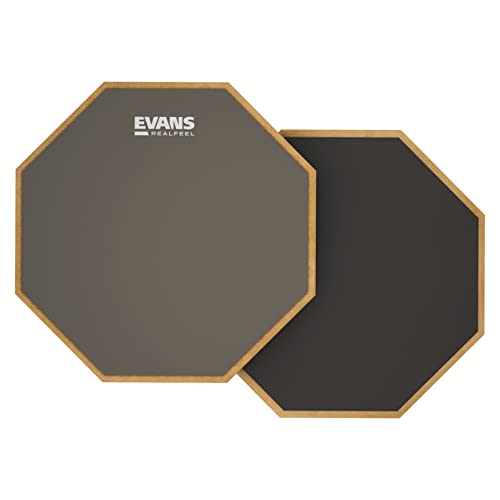 Evans RealFeel 12-Inch Practice Pad The standard practice pad, and the single most useful thing a drum student owns. Gum rubber on one side and neoprene on the other gives a realistic rebound and a harder workout surface. | Every drum student, without exception | 9.4/10 | $44.99View on Amazon #ad · price as of October 27, 2026 · how this is funded |
| 2 |  Vic Firth PAD12H 12-Inch Double Surface Pad Vic Firth's 12-inch pad reaches the same place as the RealFeel by a different route: two surface types on a single playing face rather than one per side. Choose on feel rather than on spec — both are honest practice pads and the rest is preference. | The Vic Firth alternative to the RealFeel | 8.9/10 | $49.95View on Amazon #ad · price as of October 27, 2026 · how this is funded |
| 3 |  Vic Firth American Classic 5A Drumsticks, 4-Pair Value Pack The default drumstick. 5A is the size nearly every method book and teacher assumes, and starting anywhere else means the student's grip and rebound do not match the instruction. Vic Firth sells it to beginners as a four-pair pack, which is the right way to buy a consumable that breaks. | The stick every teacher assumes | 9.3/10 | $44.99View on Amazon #ad · price as of October 27, 2026 · how this is funded |
| 4 |  Alfred Drum Method Book 1 Snare drum from the beginning: rudiments, reading and technique, in the order a school percussion teacher will want them. It is a reading book, not a kit-groove book. | First-year percussion, school or private | 9.1/10 | $12.99View on Amazon #ad · price as of October 27, 2026 · how this is funded |
Scores are our own editorial fit rating from published specifications — the rubric is on our methodology page. They are not test results; we have not played these instruments.
Buying this as a gift? Our gift guides re-explain these picks for the gifter. Wondering whether to wait for November? The Black Friday hub has the sourced record of what discounted last year and what did not.
Why the pad matters more than the kit
Drumming skill is mostly hand technique: stick control, rebound, consistency between the two hands, and the rudiments that combine into everything else. All of that develops on a practice pad, which is quiet, portable and costs a tiny fraction of a kit.
A student with a pad and a method book progresses faster in the first year than one with a kit and no structure. This is genuinely how percussion is taught: school percussionists spend most of year one on a pad and a bell kit, not behind a drum set.
It is also the answer for a household that cannot accommodate a kit. A pad is quiet enough for a bedroom with people asleep in the next room.
What the surfaces mean
| Surface | Rebound | Trains |
|---|---|---|
| Gum rubber | Close to a real drum head | Realistic technique that transfers directly to a kit |
| Neoprene / harder rubber | Less rebound; the stick has to be lifted | Hand strength and control, because nothing is given back |
| Mylar over rubber | Slightly more rebound, closer to a snare head | Snare-specific technique |
| Wood or hard plastic | Very lively, loud | Nothing a beginner needs; too far from a real drum |
A double-sided pad with gum rubber on one face and neoprene on the other covers both realistic practice and strength work in one object, which is why it is the standard recommendation.
How to actually use one
- 1
Mount it, or use a firm surface
A pad on a snare stand sits at playing height and does not move. On a lap or a soft sofa arm the pad absorbs the stroke and the rebound is wrong. A table works if the pad has a non-slip base.
- 2
Start with single strokes at a slow tempo
Alternating hands, one stroke each, with a metronome. The goal is not speed — it is that every stroke sounds identical, both hands equal. Most beginners have a noticeably weaker non-dominant hand and this is where that gets fixed.
- 3
Add doubles and paradiddles
The next two rudiments in almost every method: double strokes, then the paradiddle pattern of right-left-right-right, left-right-left-left. These three cover an enormous amount of real playing.
- 4
Use a metronome, slowly
Set it slower than feels necessary and stay there until every stroke is even. Speed comes from control rather than from attempting speed, and this is the single most common beginner error.
- 5
Ten to fifteen minutes a day
Daily beats long. Hand technique consolidates between sessions rather than during them, so frequency matters more than duration on a pad more than almost anywhere else.
Get the grip checked early
A pad is excellent for practicing and cannot tell a student their grip is wrong. A poor grip — too tight, thumb in the wrong place, no fulcrum — limits speed and control permanently and becomes very hard to unlearn.
Even a single lesson to establish the grip is worth more than months of unsupervised pad practice reinforcing a bad one. This is the one place we would not recommend going it alone.
Sticks
5A is the standard beginner size and is what every method book and teacher assumes. Hickory absorbs shock better than maple or oak, which matters for a developing grip.
Buy spares. Sticks break, usually mid-session and usually the evening before a lesson. A pair costs very little and a student with no sticks practices nothing.
Pad plus book plus metronome
That is the complete first-year percussion setup and it costs less than the cymbals on a beginner kit. Add a method book for structure and a metronome for timing, and a student can develop genuinely well without owning a drum.
When the kit question does come around — and on a student who sticks with it, it does — the beginner drum set roundup covers what a complete first kit actually includes, because the cymbals are where a cheap kit saves its money.
A pad is only half the purchase. The other half is the sticks, and for a beginner the size matters more than the brand: 5A is what method books and teachers assume, and a smaller child may need to start lighter. That decision is on our page on what size drum sticks a beginner needs.
A pad on a stand only helps if the player is sitting at the right height, which is the one thing a kitchen chair cannot do. Our drum thrones page covers how to set that height and which seat shape suits which player.
The picks, in full
Every card below is written from the published specification and the manufacturer’s own documentation. We have not played these instruments — see how we work for exactly what that means and what we do instead.
Our top pick · Every drum student, without exception
Evans RealFeel 12-Inch Practice Pad
The standard practice pad, and the single most useful thing a drum student owns. Gum rubber on one side and neoprene on the other gives a realistic rebound and a harder workout surface.
What works
- Two surfaces: realistic rebound on one side, harder practice on the other
- Genuinely quiet enough for a shared room
- Effectively indestructible
What to know
- Needs a stand or a lap to be used properly
- Only teaches hands — nothing about feet or coordination
- Diameter
- 12 in
- Surfaces
- Gum rubber and neoprene
#ad · price as of October 27, 2026 · how this is funded
Specs read from the manufacturer or retailer listing on 2026-09-07. Our fit score: 9.4/10.
Pick 2 · The Vic Firth alternative to the RealFeel
Vic Firth PAD12H 12-Inch Double Surface Pad
Vic Firth's 12-inch pad reaches the same place as the RealFeel by a different route: two surface types on a single playing face rather than one per side. Choose on feel rather than on spec — both are honest practice pads and the rest is preference.
What works
- Two published surface types, so realistic rebound and harder work live on the same pad
- Natural rubber on a wooden base rather than a hollow shell
- Vic Firth states low-volume practice as the point, which is what a pad is for
What to know
- One playing face, not two — a true double-sided pad gives a full surface of each
- No stand included, and the listing does not publish a stand-mount thread
- Diameter
- 12 in
- Surfaces
- Two surface types, one playing side
- Construction
- Natural rubber on a wooden base
#ad · price as of October 27, 2026 · how this is funded
Specs read from the manufacturer or retailer listing on 2026-09-30. Our fit score: 8.9/10.
Pick 3 · The stick every teacher assumes
Vic Firth American Classic 5A Drumsticks, 4-Pair Value Pack
The default drumstick. 5A is the size nearly every method book and teacher assumes, and starting anywhere else means the student's grip and rebound do not match the instruction. Vic Firth sells it to beginners as a four-pair pack, which is the right way to buy a consumable that breaks.
What works
- 5A is the universal reference size for a beginner
- Hickory absorbs shock better than maple or oak for a developing grip
- Four matched pairs in the box, so the spares are already bought when one breaks
What to know
- Wood tips chip; nylon tips last longer but sound different on cymbals
- Sold only as a multi-pair pack, so the outlay is higher than one pair even though the per-pair cost is lower
- Size
- 5A
- Wood
- American hickory
- Tip
- Wood, teardrop
- Pack
- 4 pairs (model P5A.3-5A.1)
#ad · price as of October 27, 2026 · how this is funded
Specs read from the manufacturer or retailer listing on 2026-10-09. Our fit score: 9.3/10.
Pick 4 · First-year percussion, school or private
Alfred Drum Method Book 1
Snare drum from the beginning: rudiments, reading and technique, in the order a school percussion teacher will want them. It is a reading book, not a kit-groove book.
What works
- Builds reading and rudiments together from page one
- The standard first snare book in US school percussion
- Works on a practice pad, so no kit is needed
What to know
- Teaches snare drum, not drum-kit grooves — a student who wants beats will be impatient
- Needs a teacher to correct grip early
- Level
- Book 1
- Focus
- Snare drum, rudiments and reading
- Kit grooves
- Not covered at this level
#ad · price as of October 27, 2026 · how this is funded
Specs read from the manufacturer or retailer listing on 2026-09-07. Our fit score: 9.1/10.
Questions people actually ask
Are drum practice pads worth it?
They are the most useful object a drum student owns. Hand technique — stick control, rebound, evenness between the hands — develops on a pad, quietly and portably, for a tiny fraction of the cost of a kit.
What size drum practice pad should I get?
Twelve inches, which is close to a real snare drum's playing area and gives room to practice moving around the head. Smaller pads are more portable and cramped; larger ones offer nothing extra for a beginner.
Can you learn drums with just a practice pad?
You can develop most of the hand technique, which is the majority of first-year drumming. What a pad cannot teach is coordination between hands and feet, which needs a kit or an electronic set eventually.
What drumsticks should a beginner use?
5A hickory. It is the standard size every method book and teacher assumes, and hickory absorbs shock better than maple or oak for a developing grip. Buy spares, because sticks break at inconvenient moments.
Sources
We have not played these instruments, so citation is our evidence. Everything above traces back to one of these, on the date shown.