The best viola method books for a beginner
Viola method books are not violin books in a different key. The clef is different, the in-print editions are fewer, and buying the wrong one is the commonest first mistake a viola parent makes.
By Stephen V. · Writes Reed & Rosin · last verified
The short answer
Ask the orchestra director which book the program uses before you buy anything. If nobody has told you, Essential Elements for Strings Viola Book 1 is the right default: it teaches alto clef from page one and its parts align with the violin, cello and bass editions. Suzuki only makes sense with a Suzuki-trained teacher.
Some links on this page earn us a commission at no extra cost to you. It does not change which instrument we recommend, and it does not change the order. We also earn nothing when the honest answer is “rent it” — and we still say so. Full disclosure.
Quick picks
| # | Product | Best for | Score | Price |
|---|---|---|---|---|
| 1 |  Essential Elements for Strings Book 1 - Viola (with EEi) The book a school orchestra will almost certainly hand your child, and the right default buy if nobody has told you otherwise. It teaches note reading from page one, and the viola part is page-aligned with the violin, cello and bass editions so a mixed class plays the same bar at the same time. | A school orchestra violist | 9.2/10 | |
| 2 |  All for Strings Book 1 - Viola (78VA) The other classroom method American orchestra programs use, and the one to buy if your director named it. Functionally it does the same job as Essential Elements; which of the two is correct is decided entirely by what the rest of the class is holding. | A program that teaches from All for Strings | 8.2/10 | $8.50View on Amazon #ad · price as of November 7, 2026 · how this is funded |
| 3 | 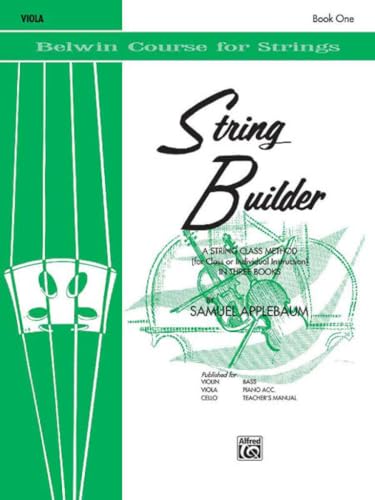 String Builder Bk 1 - Viola (Belwin Course for Strings) The old-school alternative, and usually the cheapest real method here. Samuel Applebaum's sequence is thinner, drier and faster-moving than the classroom methods, which is exactly why some private teachers still prefer it: a student who needs more notes per page rather than more encouragement gets further with this. | A private student whose teacher wants pace over polish | 7.8/10 | $9.99View on Amazon #ad · price as of November 7, 2026 · how this is funded |
| 4 |  Suzuki Viola School Vol 1: Viola Part Buy this when a Suzuki-trained teacher asks for it, and not otherwise. It is a repertoire sequence inside a specific teaching method, not a self-teaching book — a parent who buys it hoping it will teach a child to read music has bought the wrong kind of object. | A student with a Suzuki-trained viola teacher | 8.4/10 | $14.99View on Amazon #ad · price as of November 7, 2026 · how this is funded |
| 5 |  Scales for Young Violists Barbara Barber The second book to buy, not the first. A method book teaches pieces; this teaches the scale patterns the pieces assume, which is the gap most second-year violists fall into. Buy it when a teacher starts asking for scales by name. | A second-year student whose teacher assigns scales | 8.0/10 | $12.99View on Amazon #ad · price as of November 7, 2026 · how this is funded |
| 6 |  Essential Elements for Strings Book 2 - Viola (with EEi) The book your child needs in year two, and the reason to start with Essential Elements rather than a method that stops. Continuing the same sequence costs a student nothing in relearning, which is not true of switching methods mid-stream. | Year two in the same program | 8.6/10 | $12.98View on Amazon #ad · price as of November 7, 2026 · how this is funded |
Scores are our own editorial fit rating from published specifications — the rubric is on our methodology page. They are not test results; we have not played these instruments.
The viola is not a violin, and the book is the proof
A violist reads alto clef. Nobody else in the orchestra does, which makes the viola the only string instrument whose beginner cannot borrow a sibling’s book, use a free violin PDF, or follow along with the violin section of a mixed-instrument method. Middle C sits in the middle of the staff instead of below it, every note a beginner learns in the first month is in a different place on the page than it would be for a violinist, and a child who learns the violin positions first has to unlearn them.
This is why the first purchase matters more here than it does for violin. There are fewer viola methods in print, they are stocked more thinly, and the violin edition of the same book sits directly beside the viola edition in every search result — usually cheaper, because more copies sell. Ordering the violin edition of the right method is the single commonest mistake a viola parent makes, and it is not recoverable: the notes on the page are wrong for the instrument.
If you have not chosen the instrument yet, start with our beginner viola roundup and our viola sizing guide, which measures by arm length rather than age. Come back here once the instrument is decided, because the book depends on where the student is going to be taught rather than on what they are playing.
Ask the director before you buy anything
We say this on every school-instrument page on this site and it is more true for viola than for anything else: if the student is joining a school orchestra, the program has already chosen the book. There are two mainstream American classroom string methods, they are roughly equivalent in quality, and they are not interchangeable in a classroom. A student holding All for Strings in a room working from Essential Elements is on a different page, literally, every single lesson.
One email or one question at the first parents’ meeting settles it, and it saves the most annoying version of this purchase — owning the right method for the wrong program. Our guide to asking the band or orchestra director has the three questions worth asking, and “which method book does the orchestra use, and which edition” is the first of them.
If nobody answers before the first lesson
Buy Essential Elements for Strings Viola Book 1. It is the most widely used classroom string method in American schools, it teaches reading from the first page, and if it turns out the program uses something else you own a perfectly good book that a private teacher can work from. The reverse bet — buying Suzuki on spec — is the one that wastes money, because Suzuki without a Suzuki teacher is close to unusable.
Two kinds of book, and only one of them teaches reading
Almost all the confusion in this purchase comes from treating four books as four versions of the same thing. They are not. A method teaches note reading, rhythm and technique in a designed sequence, and a student can work through it. A repertoire book is a sequence of pieces ordered by technical demand, designed to be used inside a teaching approach that supplies everything else. And a studies book drills one skill — scales, shifting — for a student who already has a method.
| Book | What kind of book it is | Who it is for | Teaches reading |
|---|---|---|---|
| Essential Elements for Strings - Viola Book 1 | Classroom method with online audio | A school orchestra student, or a private student with no book specified | Yes, alto clef from page one |
| All for Strings Book 1 - Viola | Classroom method | A program that teaches from All for Strings, and only that | Yes, from page one |
| String Builder Bk 1 - Viola | Older method, class or individual | A private student whose teacher wants pace and fewer distractions | Yes, more briskly and with far less support |
| Suzuki Viola School Vol 1 | Repertoire sequence inside a pedagogy | A student with a Suzuki-trained viola teacher | Minimally in the early volumes |
Buying Suzuki Volume 1 for a self-teaching student is not a slightly worse choice - it is buying the wrong kind of object. The same point applies to violin and is made at greater length on our violin method page.
The practical reading: most beginner violists should own one classroom method, chosen by their program, and nothing else for the first year. A second book bought at the same time almost always goes unopened, because a beginner has no spare practice time and a parent has no way to sequence two books against each other.
How we chose these
We have not taught from every one of these books, and we say so on every page — see how we research these picks. The criteria below are ones a published edition can actually answer, applied in this order.
| Criterion | What we required | Why it decides anything |
|---|---|---|
| A real viola edition | Published for viola in alto clef, not a violin book with a note about transposing | A violist cannot use a violin book. This is the one criterion that disqualifies outright |
| Classroom alignment | Parts that match the violin, cello and bass editions page for page | A school orchestra plays from four editions of one book at once. Misalignment is the whole failure mode |
| Reading from the start | Note reading taught in the first pages rather than assumed | A beginner violist who cannot read alto clef cannot play their own orchestra part, however well they play by ear |
| Home-practice support | Published audio or online access, or an honest note that there is none | Most practice happens with no teacher in the room. Audio is the difference between practice and guessing |
| Still in print and in stock | A purchasable state on the dated read, not a marketplace-only listing | Out-of-print viola editions are a real problem in this category. A recommendation you cannot buy is not a recommendation |
| A reorderable edition code | An ISBN or catalog number that identifies the viola edition specifically | It is how you avoid ordering the violin book. For All for Strings the code (78VA) is more reliable than the title |
Fit scores on the cards are editorial judgments from these published criteria. They are not test results and we never emit them as rating data.
Essential Elements against All for Strings
These are the two books a school program will be using, and the honest answer is that the difference between them matters far less than matching whichever one your program chose. Both teach alto clef from the start, both align across the string family, both sequence a first year sensibly.
| Essential Elements for Strings | All for Strings | |
|---|---|---|
| Online audio | EEi access included with the book | None published with the book |
| Theory workbook | Theory is built into the method | A separate matching workbook exists at each level |
| Identified by | Title and ISBN | Catalog number as often as title - viola is 78VA |
| Second-year continuation | Book 2 in the same sequence, viola edition in print | Book 2 and Book 3 in the same sequence |
| Typical price | A little higher | Usually the cheaper of the two |
| Best reason to pick it | The online audio, if home practice is unsupervised | Your program uses it |
If you have a genuine free choice - a private teacher with no preference, or a self-directed adult beginner - take Essential Elements for the audio. It is the only one of the two with a home-practice component included.
Where String Builder still earns its place
String Builder is older than both classroom methods and reads like it. There is almost no page furniture: no photographs, no colored boxes, no app. For a nine-year-old working alone that is a real disadvantage, and we would not recommend it as a first book for a student without a teacher.
For a student with a teacher it can be the better book, and some private viola teachers still prefer it for exactly the reason it looks dated: more exercises per page, less time spent on presentation, and a faster climb. It is also usually the cheapest viola method in print, which makes it a sensible second method for a student who has finished a classroom Book 1 and wants more material at the same level rather than moving up.
Suzuki, and the question to ask first
Suzuki Viola School Volume 1 is an excellent book being bought by the wrong people. It is a repertoire sequence built for a teaching method that depends on listening, imitation, repetition and an involved parent in the room, and the early volumes teach note reading only lightly because reading is deliberately introduced later in that approach.
So the question is not “is Suzuki good” but “is there a Suzuki-trained viola teacher.” Suzuki viola teachers are considerably scarcer than Suzuki violin teachers, and a violin-trained Suzuki teacher taking a viola student is common and fine — but the book still has to be the viola edition. If the answer is no teacher, buy a classroom method instead. If the answer is yes, buy whatever volume and edition that teacher names, including whether they want the recording, because the book-only and book-with-audio editions are separately listed and priced.
Which book for which situation
| If this is you | Buy | Because |
|---|---|---|
| Joining a school orchestra and the director named a book | The book the director named, in the viola edition | Classroom alignment beats every other consideration on this page |
| Joining a school orchestra and nobody has said | Essential Elements for Strings Viola Book 1 | The most widely used classroom string method in American schools, and useful even if the program differs |
| Your program uses All for Strings | All for Strings Book 1 - Viola (78VA) | Order it by the catalog number; the title alone invites the violin edition |
| A private student whose teacher wants pace | String Builder Bk 1 - Viola | More exercises per page, less presentation, cheapest method in print |
| A student with a Suzuki-trained teacher | Suzuki Viola School Vol 1 - Viola Part | It is the book that teacher's lesson plans assume. Confirm whether they want the audio edition |
| Second year, scales now being assigned | Scales for Young Violists | Written for viola rather than transposed, and it does not compete with the method book |
| Finishing Book 1 in a program using Essential Elements | Essential Elements for Strings Viola Book 2 | Continuing the same sequence costs nothing in relearning; switching methods mid-stream does |
Year two is where books get bought badly
The first-year purchase is usually fine because somebody tells you what to get. The second year is where money gets wasted, in two predictable ways.
The first is buying Book 2 early. It genuinely starts where Book 1 ends; a student halfway through Book 1 gets nothing from owning the next one except the feeling of being behind. The second is switching methods between years, usually because the first book felt slow. Switching costs a student weeks, because the two methods introduce keys and positions in a different order and a student who jumps lands in a chapter that assumes material they have not met.
The right second purchase, if a teacher is asking for more, is not another method at all — it is a studies book. A scale book sits alongside whatever method the program uses and drills the patterns the pieces assume. That is the gap most second-year violists actually fall into, and it is the only reason there is a scale book on this page.
What not to buy
A violin book with the intention of transposing. It is sometimes suggested as a saving and it is a bad idea. A beginner cannot transpose at sight, that is the skill the book is supposed to be building, and the first month of practice becomes an exercise in arithmetic rather than music.
A piano accompaniment book. These are sold beside the method books and look like part of the set. Unless someone in the house plays piano well enough to accompany, it will not be opened.
A general music-theory book, in year one. Theory is genuinely useful and both classroom methods already include enough of it for a first year. If the student is ready for more, our music theory book guide covers which one and when — it is a year-two or year-three purchase for most students.
Anything digital as a substitute. Apps and subscriptions are fine supplements and a poor replacement for the book an orchestra is reading from. The student needs the physical page the class is on, open on the stand, with the teacher’s pencil marks on it.
A two-minute check before you order
Confirm the word “Viola” appears in the title you are ordering, not just in the search you typed. Check the edition code if there is one — 78VA for All for Strings Book 1 viola. Confirm the book number matches what the teacher asked for, since Book 1 and Book 2 listings look nearly identical. And decide whether you need the audio edition before you order, because the book-only and book-plus-audio editions are separate listings at different prices.
The picks, in full
Every card below is written from the published specification and the manufacturer’s own documentation. We have not played these instruments — see how we work for exactly what that means and what we do instead.
Our top pick · A school orchestra violist
Essential Elements for Strings Book 1 - Viola (with EEi)
The book a school orchestra will almost certainly hand your child, and the right default buy if nobody has told you otherwise. It teaches note reading from page one, and the viola part is page-aligned with the violin, cello and bass editions so a mixed class plays the same bar at the same time.
What works
- Page-aligned with the violin, cello and bass editions, which is the whole point in a classroom
- Teaches reading in alto clef from the first page rather than assuming it
- EEi online audio means a student can hear the piece at home without a teacher present
What to know
- Classroom pacing is deliberately slow and a motivated private student will outgrow the first half quickly
- The repertoire is functional rather than beautiful — these are exercises with tunes attached
- Viola and violin editions sit side by side in search results; check you are buying the viola one
- Level
- Book 1
- Instrument
- Viola (alto clef)
- Setting
- Classroom orchestra
- Online resources
- EEi access included
- Page count
- Not published
Specs read from the manufacturer or retailer listing on 2026-11-06. Our fit score: 9.2/10.
Pick 2 · A program that teaches from All for Strings
All for Strings Book 1 - Viola (78VA)
The other classroom method American orchestra programs use, and the one to buy if your director named it. Functionally it does the same job as Essential Elements; which of the two is correct is decided entirely by what the rest of the class is holding.
What works
- A genuine classroom orchestra method with parts aligned across the string family
- A matching theory workbook exists at the same level, which some programs assign
- Typically the cheapest of the two mainstream classroom methods
What to know
- No online audio package comparable to EEi, which matters for home practice
- Only worth owning if your program uses it — otherwise you have bought the wrong classroom book
- Sold by catalog number (78VA) as often as by name, which makes it easy to order the violin edition by mistake
- Level
- Book 1
- Instrument
- Viola
- Catalog number
- 78VA
- Setting
- Classroom orchestra
- Online resources
- Not published
#ad · price as of November 7, 2026 · how this is funded
Specs read from the manufacturer or retailer listing on 2026-11-06. Our fit score: 8.2/10.
Pick 3 · A private student whose teacher wants pace over polish
String Builder Bk 1 - Viola (Belwin Course for Strings)
The old-school alternative, and usually the cheapest real method here. Samuel Applebaum's sequence is thinner, drier and faster-moving than the classroom methods, which is exactly why some private teachers still prefer it: a student who needs more notes per page rather than more encouragement gets further with this.
What works
- Works as a class method or for individual instruction, which the title says plainly
- Moves faster than the classroom methods, with less page furniture around each exercise
- Usually the least expensive viola method in print
What to know
- No online audio, no video, no app — this is a book from a different era and reads like one
- Sparse presentation gives a young self-teaching student almost nothing to hold onto
- Not what a school program will be working from, so a classroom student would own two books
- Level
- Book 1
- Instrument
- Viola
- Setting
- Class or individual instruction
- Series
- Belwin Course for Strings
- Online resources
- Not published
#ad · price as of November 7, 2026 · how this is funded
Specs read from the manufacturer or retailer listing on 2026-11-06. Our fit score: 7.8/10.
Pick 4 · A student with a Suzuki-trained viola teacher
Suzuki Viola School Vol 1: Viola Part
Buy this when a Suzuki-trained teacher asks for it, and not otherwise. It is a repertoire sequence inside a specific teaching method, not a self-teaching book — a parent who buys it hoping it will teach a child to read music has bought the wrong kind of object.
What works
- The standard first volume for Suzuki viola study, so a teacher's lesson plans assume it
- Repertoire is genuinely musical from early on, which keeps a young student engaged
- The viola sequence mirrors the violin one, so siblings on the two instruments progress in step
What to know
- Teaches note reading only minimally in the early volumes — it is designed around listening and imitation
- Close to useless without a Suzuki-trained teacher, and those are far scarcer for viola than for violin
- This is the book-only edition; the recording is a separate purchase
- Level
- Volume 1
- Instrument
- Viola part
- Method
- Suzuki (teacher-led)
- Audio included
- No — book-only edition
#ad · price as of November 7, 2026 · how this is funded
Specs read from the manufacturer or retailer listing on 2026-11-06. Our fit score: 8.4/10.
Pick 5 · A second-year student whose teacher assigns scales
Scales for Young Violists Barbara Barber
The second book to buy, not the first. A method book teaches pieces; this teaches the scale patterns the pieces assume, which is the gap most second-year violists fall into. Buy it when a teacher starts asking for scales by name.
What works
- Written for viola rather than transposed from a violin edition
- Scale patterns are laid out to be practiced, not just referenced
- Pairs with either classroom method — it does not compete with the book the program uses
What to know
- Useless as a first book; it assumes a student can already read and hold the instrument
- A scale book is a hard sell to a nine-year-old without a teacher driving it
- No audio or online component
- Level
- Young / early intermediate
- Instrument
- Viola
- Type
- Scale and technique studies
- Author
- Barbara Barber
#ad · price as of November 7, 2026 · how this is funded
Specs read from the manufacturer or retailer listing on 2026-11-06. Our fit score: 8.0/10.
Pick 6 · Year two in the same program
Essential Elements for Strings Book 2 - Viola (with EEi)
The book your child needs in year two, and the reason to start with Essential Elements rather than a method that stops. Continuing the same sequence costs a student nothing in relearning, which is not true of switching methods mid-stream.
What works
- Continues the Book 1 sequence with no relearning, and stays page-aligned across the string family
- EEi online access carries over, so the home-practice audio does not disappear
- Introduces positions and keys a second-year orchestra part will actually ask for
What to know
- Buying it early does nothing — it genuinely starts where Book 1 ends
- Still classroom-paced, so a fast private student may be bored in both books
- Level
- Book 2
- Instrument
- Viola (alto clef)
- Setting
- Classroom orchestra
- Online resources
- EEi access included
#ad · price as of November 7, 2026 · how this is funded
Specs read from the manufacturer or retailer listing on 2026-11-06. Our fit score: 8.6/10.
Questions people actually ask
Can a beginner violist use a violin method book?
No. The viola reads alto clef, so every note in a violin book sits in a different place on the staff than it does for a violist. Transposing at sight is the skill the method book is meant to build, so asking a beginner to do it while learning defeats the purpose. Buy the viola edition.
Which viola method book do school orchestras use?
Most American school orchestra programs use either Essential Elements for Strings or All for Strings, both of which publish a viola edition with parts aligned to the violin, cello and bass books. The two are not interchangeable in a classroom, so ask the orchestra director which one before buying.
Is Suzuki good for a beginner viola student?
Only with a Suzuki-trained teacher. Suzuki Viola School Volume 1 is a repertoire sequence inside a specific teaching approach that relies on listening, imitation and parental involvement; the early volumes teach note reading only minimally. Without that teacher, a classroom method is the better buy.
Do I need the book with the CD or audio?
It depends on the method. Essential Elements includes EEi online access with the book, so the audio comes anyway. Suzuki sells book-only and book-with-recording editions separately at different prices, so confirm with the teacher which one they expect before ordering.
When should a beginner violist buy a scale book?
In year two, and usually when a teacher starts asking for scales by name. A scale book assumes a student can already read and hold the instrument, so it is useless as a first purchase - but it fills the gap most second-year students fall into, and it sits alongside whichever method the program uses rather than replacing it.
Sources
We have not played these instruments, so citation is our evidence. Everything above traces back to one of these, on the date shown.