Ukulele or guitar first?
The chord shapes genuinely transfer, so this is not a wasted-effort question. It is a question about which instrument gets played this month.
By Stephen V. · Writes Reed & Rosin · last verified
The short answer
The ukulele is physically much easier: four soft nylon strings under low tension, and several chords that need one finger. Its chord shapes transfer directly to guitar, so nothing is wasted. Choose guitar first only if the player specifically wants guitar music.
Some links on this page earn us a commission at no extra cost to you. It does not change which instrument we recommend, and it does not change the order. We also earn nothing when the honest answer is “rent it” — and we still say so. Full disclosure.
Quick picks
| # | Product | Best for | Score | Price |
|---|---|---|---|---|
| 1 |  Kala KA-15S Soprano Bundle The reference beginner soprano. Mahogany body, geared tuners that actually hold pitch, and a bundle that includes the tuner and bag most first buyers forget to order. | The default first ukulele | 9.3/10 | $99.99View on Amazon #ad · price as of October 27, 2026 · how this is funded |
| 2 | 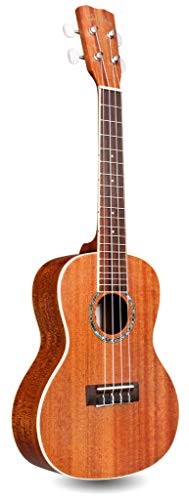 Cordoba 15CM Concert A concert body adds about two inches of scale over a soprano, which is exactly the difference between an adult crowding the frets and an adult playing comfortably. | Adult beginners and larger hands | 9.0/10 | $129.99View on Amazon #ad · price as of October 27, 2026 · how this is funded |
| 3 |  Yamaha FG820 A solid Sitka spruce top over mahogany back and sides, which is the one spec set that actually changes how a guitar sounds as it ages. If an adult beginner asks for one recommendation and nothing else, this is it. | Adult beginners who want one guitar for years | 9.2/10 | $389.99View on Amazon #ad · price as of October 27, 2026 · how this is funded |
| 4 |  Yamaha JR1 FG Junior A 3/4-scale guitar built to the same standard as Yamaha's adult line rather than a toy with a brand on it. The right first acoustic for roughly ages 8 to 11, and it holds resale value. | Ages 8-11 on a first steel-string | 9.0/10 | $189.99View on Amazon #ad · price as of October 27, 2026 · how this is funded |
Scores are our own editorial fit rating from published specifications — the rubric is on our methodology page. They are not test results; we have not played these instruments.
What actually transfers
More than most people expect, and this is the fact that makes the whole question low-stakes. A ukulele in standard tuning is pitched like the top four strings of a guitar with a capo at the fifth fret. In practical terms:
- Chord shapes transfer directly. A ukulele G shape is a guitar D shape. A ukulele C is a guitar G. The hand learns the geometry once.
- Strumming transfers completely. The right hand does the same thing on both instruments.
- Reading, rhythm and theory transfer completely. None of it is instrument-specific.
- What does not transfer: the two extra strings, and the finger strength for steel-string guitar. Both are picked up in weeks.
Side by side
| Ukulele | Guitar | |
|---|---|---|
| Strings | 4, nylon, low tension | 6, steel or nylon, higher tension |
| Finger pain | Essentially none | Two weeks of genuine discomfort on steel |
| First chord | Often one finger | Usually three fingers |
| First recognisable song | An afternoon | Two to six weeks |
| Cost of a usable instrument | Low | Meaningfully higher |
| Size for a small child | Fits from about 4 | Needs a fractional size and a fit check |
| Musical range | Limited — no bass strings | Wide, and it accompanies singing better |
| Repertoire available | Large and growing | Effectively unlimited |
The case for starting on ukulele
Early success is not a soft consideration. The strongest predictor of whether a beginner is still playing in six months is whether they produced something that sounded like music in their first few sessions. The ukulele delivers that better than any other instrument here.
For a child under about eight, it is also frequently the only option that physically fits. A 1/4 guitar is a real thing and it is still a six-string steel instrument with all the finger pressure that implies.
The case for going straight to guitar
If the player wants to play guitar — specific songs, a specific band, the specific sound — put a guitar in their hands. Motivation is worth more than the physical advantage, and a teenager handed a ukulele when they asked for a guitar will read it as a fob-off, which it is.
Guitar also accompanies singing better, because the bass strings supply a low root note the ukulele simply does not have. For a singer-songwriter that is not a nuance, it is the point of the instrument.
The ukulele is not only a stepping stone
It is worth saying plainly, because the framing of this question implies otherwise. The ukulele is a complete instrument with a real repertoire, capable of melody, fingerpicking and genuine musical depth. A player who starts on ukulele and stays there has not failed to progress to something better.
Plenty of people are happier with a ukulele than they would have been with a guitar, for the entirely sufficient reason that they pick it up more often.
The pragmatic answer
For a child under eight, or an adult who has tried guitar and given up on the finger pain: ukulele. For a player who specifically wants guitar, or who wants to accompany their own singing: guitar. For anyone genuinely undecided: ukulele, because it costs less, hurts less, and every shape learned is a shape a guitar will want later.
The picks, in full
Every card below is written from the published specification and the manufacturer’s own documentation. We have not played these instruments — see how we work for exactly what that means and what we do instead.
Our top pick · The default first ukulele
Kala KA-15S Soprano Bundle
The reference beginner soprano. Mahogany body, geared tuners that actually hold pitch, and a bundle that includes the tuner and bag most first buyers forget to order.
What works
- Geared tuners rather than friction pegs — the single biggest predictor of whether a cheap ukulele stays in tune
- Satin mahogany gives a warmer voice than the laminate-and-gloss competition
- Bundle covers the gig bag, tuner and strap
What to know
- Soprano is small: adult hands with wide fingers will crowd the frets
- Factory strings are worth replacing before the instrument is judged
- Size
- Soprano (approx. 21 in)
- Scale length
- 13.6 in (345 mm)
- Body
- Mahogany
- Tuners
- Geared
#ad · price as of October 27, 2026 · how this is funded
Specs read from the manufacturer or retailer listing on 2026-09-07. Our fit score: 9.3/10.
Pick 2 · Adult beginners and larger hands
Cordoba 15CM Concert
A concert body adds about two inches of scale over a soprano, which is exactly the difference between an adult crowding the frets and an adult playing comfortably.
What works
- Concert scale gives noticeably more room between frets than a soprano
- Mahogany top, back and sides for a warm, even voice
- Abalone rosette and cleaner finish work than the price implies
What to know
- Sold as an instrument alone on most listings — add a bag and a tuner
- Slightly louder and deeper than the classic bright soprano sound some people want
- Size
- Concert (approx. 23 in)
- Scale length
- 14.75 in (375 mm)
- Body
- Mahogany top, back and sides
#ad · price as of October 27, 2026 · how this is funded
Specs read from the manufacturer or retailer listing on 2026-09-07. Our fit score: 9.0/10.
Pick 3 · Adult beginners who want one guitar for years
Yamaha FG820
A solid Sitka spruce top over mahogany back and sides, which is the one spec set that actually changes how a guitar sounds as it ages. If an adult beginner asks for one recommendation and nothing else, this is it.
What works
- Solid Sitka spruce top rather than laminate, so the tone opens up with playing time
- Mahogany back and sides and scalloped X bracing, both published rather than left blank
- Full-size dreadnought body projects enough to be satisfying unamplified
- Die-cast chrome tuners and an adjustable truss rod, so a setup is possible rather than permanent
What to know
- Full dreadnought is too big for most players under about 12
- Ships with no case, tuner or strap — budget for those separately
- Costs noticeably more than the FG800 it replaces here, which is no longer available on Amazon
- Body
- Traditional Western dreadnought, full size
- Top
- Solid Sitka spruce, scalloped X bracing
- Back and sides
- Mahogany
- Neck / fingerboard
- Nato neck, rosewood fingerboard and bridge
- Scale length
- 650 mm (25 9/16 in)
- Nut width
- 43 mm (1 11/16 in)
- Tuners
- Die-cast chrome
- Included accessories
- Not published
#ad · price as of October 27, 2026 · how this is funded
Specs read from the manufacturer or retailer listing on 2026-10-18. Our fit score: 9.2/10.
Pick 4 · Ages 8-11 on a first steel-string
Yamaha JR1 FG Junior
A 3/4-scale guitar built to the same standard as Yamaha's adult line rather than a toy with a brand on it. The right first acoustic for roughly ages 8 to 11, and it holds resale value.
What works
- 3/4 scale puts the first-position chords inside a child's reach
- Built as a real guitar, so it stays in tune and takes a setup
- Comes with a gig bag on most listings
What to know
- Shorter scale means lower string tension and a thinner voice
- A child who is already tall for their age will outgrow it fast
- Scale
- 3/4 (approx. 21 in / 540 mm)
- Top
- Spruce
- Suggested ages
- Roughly 8-11, measure rather than assume
#ad · price as of October 27, 2026 · how this is funded
Specs read from the manufacturer or retailer listing on 2026-09-07. Our fit score: 9.0/10.
Questions people actually ask
Should I learn ukulele or guitar first?
Ukulele if you are undecided, a young child, or someone who has previously given up on guitar because of finger pain. Guitar if you specifically want to play guitar music or accompany your own singing. Chord shapes transfer between them, so neither choice wastes effort.
Do ukulele chords transfer to guitar?
Directly. A ukulele is tuned like the top four strings of a guitar capoed at the fifth fret, so a ukulele G shape is a guitar D shape and a ukulele C is a guitar G. The hand learns each geometry once and reuses it.
Is ukulele easier than guitar?
Physically, by a wide margin: four soft nylon strings under low tension, and several common chords that need one or two fingers. Musically the two are the same skill applied to different numbers of strings.
Is ukulele a real instrument or just a stepping stone?
A complete instrument with its own repertoire, capable of melody, fingerpicking and real musical depth. Plenty of players are happier on ukulele than they would have been on guitar, for the entirely sufficient reason that they pick it up more often.
Sources
We have not played these instruments, so citation is our evidence. Everything above traces back to one of these, on the date shown.